

(Zero Hedge)—It’s widely accepted that quantum computing remains a long-term bet, with meaningful commercialization unlikely before the 2030s—if not later.
Investor enthusiasm plunged sharply in early January after Nvidia CEO Jensen Huang remarked that “very useful” quantum computers are still years away. Since then, however, quantum computing stocks (IonQ, Rigetti Computing, D-Wave Quantum, and Quantum Computing) have soared, adding billions of dollars in market capitalization.

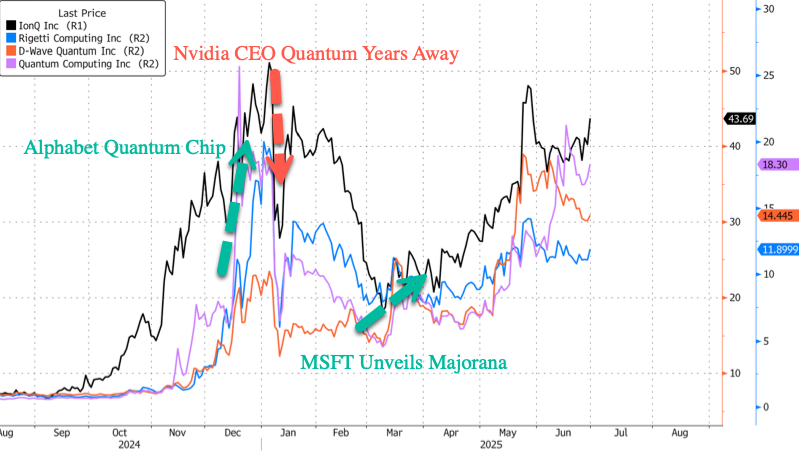
Morgan Stanley’s latest report, “Quantum Computing – How Will It Impact AI?”, offers one of the most comprehensive overviews to date, mapping out the evolving quantum landscape and its growing convergence with the artificial intelligence boom.
A team of analysts led by Shawn Kim told clients that quantum computing is entering a new era, marked by breakthroughs such as Microsoft’s ‘Majorana 1’ and Google’s ‘Willow’ chips, which promise to outperform today’s supercomputers.
They noted that these advances could accelerate AI development by enabling solutions to problems currently beyond the reach of classical computing. Rather than replacing classical systems, quantum computing is expected to serve as a powerful accelerator, enhancing AI’s capabilities, particularly in finance, logistics, pharmaceuticals, and energy.
While practical applications remain in the early stages, cloud-based access from big tech is making quantum tools increasingly accessible. Although widespread commercialization is still years away, early investments in the quantum AI ecosystem have already begun, and growing speculation over the industry’s long-term potential has sent related stocks soaring.
Here’s how the analysts frame the broader outlook for the quantum computing industry to clients:
- A Quantum leap beyond the Silicon Age. Microsoft’ Majorana 1′ or Google ‘Willow’ quantum chips were launched earlier this year, representing a paradigm shift in the ability to harness the laws of quantum mechanics to perform calculations orders of magnitude faster than today’s supercomputers. This could lead to faster breakthroughs in AI that are currently beyond the reach of classical computing, transforming how we approach complex problems, develop intelligent systems, and make predictions with a level of accuracy and speed that was previously impossible.
- A powerful synergy – augmenting AI capabilities. We view a merging of the speed of quantum computing with the learning power of AI as a partnership rather than a competition with classical computing. Quantum chips are designed to work as quantum accelerators alongside AI systems to unlock entirely new capabilities that can amplify AI’s potential beyond the reach of classical computing. The two technologies have very different strengths and therefore lend themselves to different use cases with AI excelling at creativity, language and video processing, while quantum computing is more suited for tackling complex problems that are beyond the capabilities of classical algorithms.
- There will be no shortage of commercial applications. Quantum computing has become more accessible as big tech companies are now offering services via their cloud services, narrowing the gap between theory and practical implementation with the potential to reshape many industries such as finance, pharmaceuticals, logistics and energy by solving complex AI problems much faster than classical computers. Most real-world uses are relatively small today and still in development, but the future looks promising.
- Preparing for a quantum AI future. The practical applications and integration of quantum computing into AI systems are still in the early stages of development, but much like in the early days of semiconductors, early investments in successful quantum companies and their ecosystems will likely yield substantial returns. An important question remains around the commercial timeline, although many early leaders are computing incumbents and some start-ups.
The analysts outlined the rationale behind publishing this report to clients:
Why we’re writing this report: Following our first deep dive into quantum computing nearly five years ago ( The New Processing Paradigms, 19 July 2020 ), we wanted to take stock of the many moving pieces in the sector after several tech giants released new quantum chips earlier this year. Hyperscalers such as Google (Willow), Microsoft (Majorana1), IBM and Amazon (Ocelot) are all investing in the rapidly evolving quantum race. Some of them are partnering with quantum computer companies and some are doing it in-house. In this report we focus on quantum developments and how they could impact AI in three domains – computing, metrology, and communication – in terms of commercial use cases. As the quantum computing market continues to evolve, staying informed about advances, commercial applications, and regulatory developments will be essential for making sound investment decisions in this emerging sector.
Provided more insight into quantum computing’s impacts on AI:
Quantum computing allows AI to think much faster by introducing non-deterministic and probabilistic elements that allow for more intuitive reasoning vs. current AI that is largely a sophisticated pattern recognition machine. By leveraging quantum superposition, entanglement, and interference, new quantum AI models offer the potential for significant reductions in both computational cost and energy consumption. As quantum computing develops, its integration with AI has the potential to unlock entirely new approaches that are more efficient, enable significantly better accuracy, and hence better performance. AI tools like ChatGPT have already made a profound impact on society, but a critical limitation is the need for computational behemoths using classical large language models (LLMs) that are expensive to train. With fewer parameters required, quantum models could make AI more sustainable, tackling one of the biggest challenges facing the industry today.
Quantum computers have been around for decades, but mostly as experimental models in research institutions and technology companies. Unlike classical computing models, which are binary representations of electrical switches (transistors), quantum computers measure states of subatomic particles using qubits (quantum bits). Quantum computers are still not powerful enough today to do anything commercially viable in AI, due the sensitivity of quantum systems to noise and error. A lot of effort is being made to overcome hurdles, however, industry experts and hyperscale cloud providers predict the timeline for practical commercial applications of quantum computers may only be five years out.
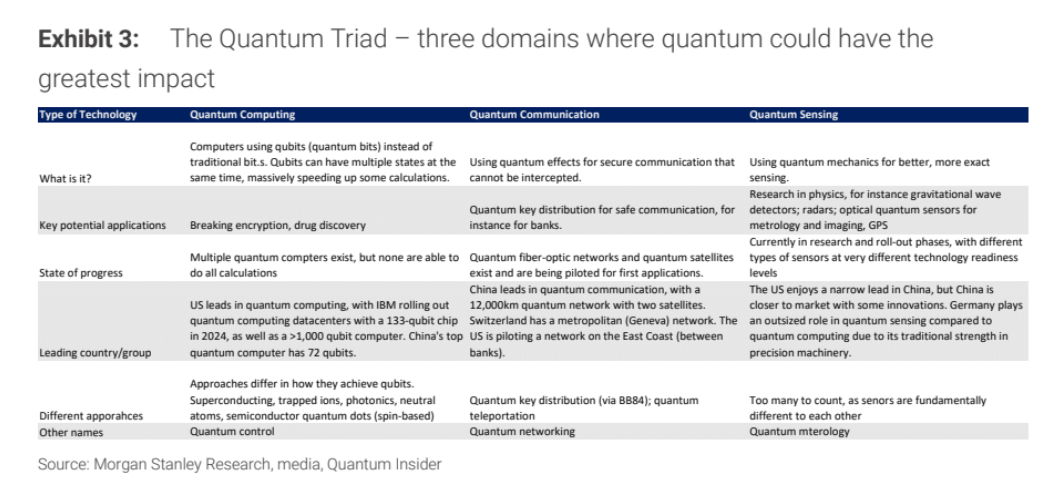
- Quantum computing. Quantum computers store and process quantum data as opposed to binary data. Unlike current AI systems, which rely on GPU (graphics processing unit) or ASIC (application-specific integrated circuit) chips, quantum computers harness technologies such as superconducting circuits, trapped ions and neutral atoms in highly isolated environments to protect their fragile processing. The main challenge lies in scaling and improving the hardware to fully exploit the potential of quantum computing, which has a number of important uses in computing fields including optimization, power efficiency, and machine learning. Quantum computers are also known for their potential to carry out ‘Shor’s Algorithm’, which can be used to factorize large numbers to decrypt data transmissions.
- Quantum communication (transfer of quantum ‘signals’). Quantum communication takes advantage of properties unique to the physics of quantum mechanics, opening new paradigms for communication that cannot be realized by classical (non-quantum) communication. Quantum communication could enhance AI’s ability to process and share real-time data across distributed networks, and provide ultra-secure data transmission. Distributed quantum computers and quantum sensors are interconnected with a quantum communication network in the quantum equivalent of the classical internet.
- Quantum metrology and sensing. This uses the physical properties of quantum systems – photons and atoms – to set standards for units of measurement in science and industry, as well as for engineering other high-precision technologies. Enhanced imaging and sensing technologies from quantum sensors, combined with AI, could achieve breakthroughs in areas such as autonomous systems, medical diagnostics and environmental monitoring. Use cases include quantum imaging or quantum radar that compromise stealth technology. It is also the only known way to detect dark matter and energy.
Before readers get too excited about quantum stocks, the analysts note: “Quantum is still very much in its infancy.”
Perhaps most intriguing, the analysts frame the quantum race as a split between the West and the East.
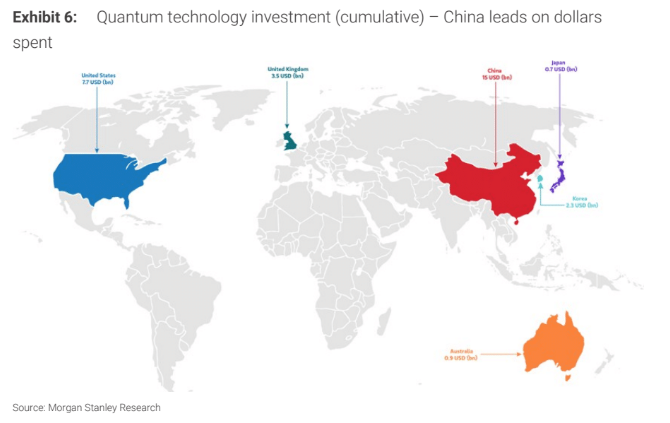
Here are the key players to watch in the space:
- IBM – Most advanced ecosystem, aiming for 200+ logical qubits and commercialization by 2029.
- Microsoft – Game-changing topological qubit architecture.
- Google – “Willow” chip achieved major error-correction milestones.
- Amazon – “Ocelot” chip; working on bosonic error correction.
- IonQ, Rigetti, Quantinuum – Specialized quantum startups with wide-ranging partnerships.
Pure Play & Big Tech Stocks
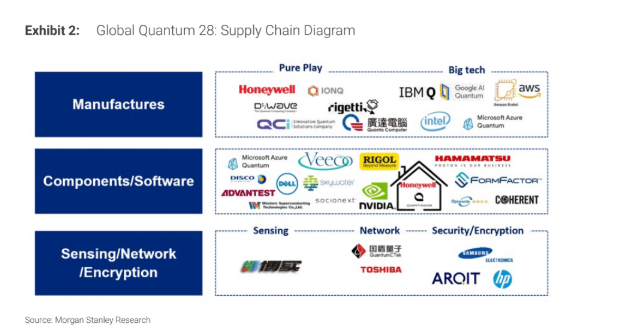
And now to the part that matters most for investors: the timeline for commercialization.

According to the analysts:
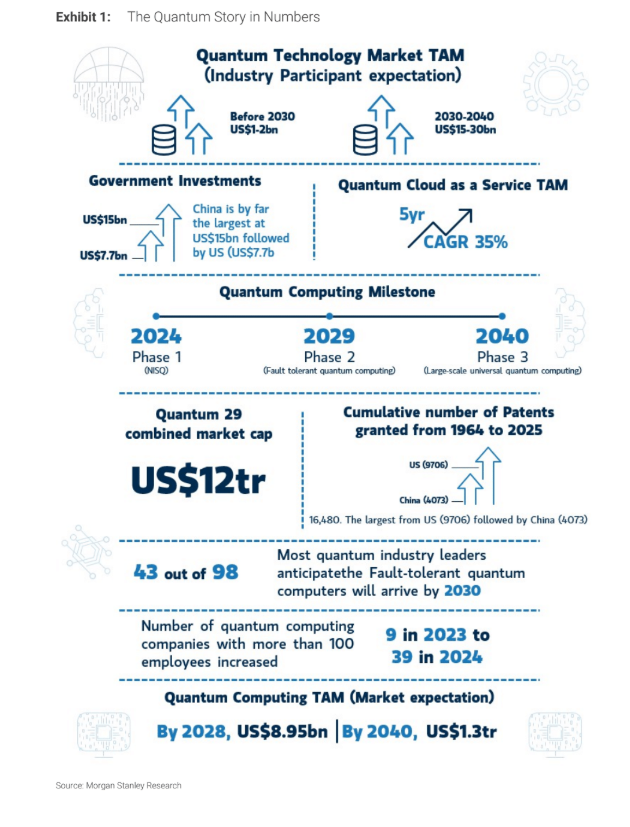
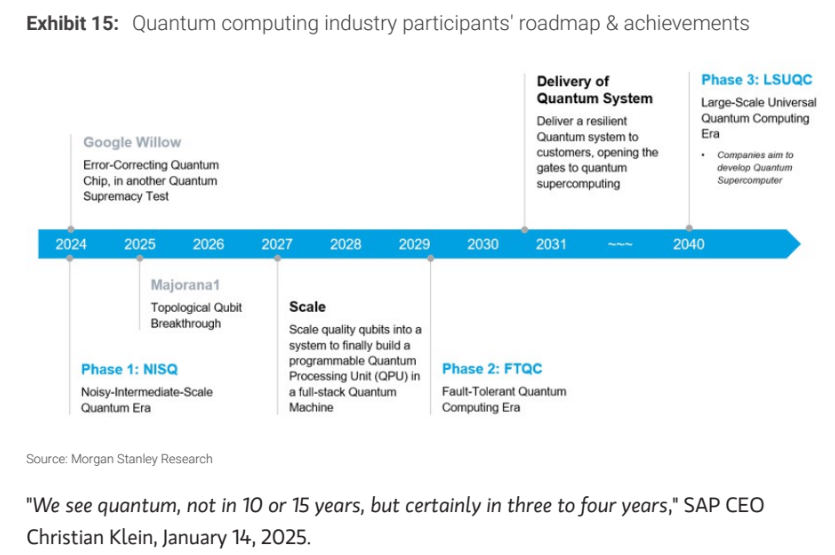
What’s the timing? The consensus quantum computing timeline suggests meaningful commercial applications emerging around 2029-30, with more advanced utility-scale quantum computing expected in the early to mid-2030s. The timing for quantum computing commercialization varies across different milestones, with several key timeframes emerging from industry experts and companies in the field. There are coordinated efforts from companies and governments to make quantum work and still primarily in the research and development phase. Many experts believe the chance of Q- day happening before 2030 is over 50%. Businesses are taking it seriously, pouring billions into preparation and will likely to begin to derive value well before via cloud offerings that are already available today for basic quantum computations.
- Current state (2025): Quantum computing is still primarily in the research and development phase. Companies like Rigetti are working on scaling their systems, with plans to reach 100+ qubits by the end of 2025 with targeted improvements in error rates.
- Commercial applications (2029-2030): Multiple sources indicate that meaningful commercial applications of quantum computing are expected in approximately 4-5 years from now:
- Cryptographic threats (2030): A cryptanalytically relevant quantum computer capable of breaking common public key schemes such as RSA or ECC is expected by 2030. The National Institute of Standards and Technology (NIST) has set 2030 as the timeline for implementing quantum-secure algorithms and deprecating currently used cryptographic methods.
The Roadmap
Read the rest of Morgan Stanley’s deep quantum computing dive—available here for pro subs.
Starting the Day With a Scripture-Inspired Roast Helps Center Your Thoughts on Eternal Truths Amid Temporal Pressures
The world can seem chaotic, especially right after we wake up. Many believers start their mornings reaching for something familiar — a hot cup of coffee — yet end up settling for mediocre brews that do little more than deliver a caffeine jolt. The daily grind of life, with its endless distractions, news cycles, and responsibilities, can leave even the most faithful feeling spiritually parched alongside their physical fatigue. What if your morning ritual could do more than wake you up? What if it could ground you in truth, nourish your body with exceptional quality, and quietly advance a kingdom purpose at the same time?
That’s the promise — and the reality — behind Promised Grounds Coffee. This Christian-founded company doesn’t just roast beans; it approaches every step as an act of worship and discipleship. By selecting only the top 10% of specialty-grade beans, ethically sourced from dedicated farmers in Central and South America, and small-batch roasting them with reverence in Austin, Texas, Promised Grounds delivers what many describe as the best coffee available — never burnt, never bland, but rich with origin stories and layered flavors that honor God’s creation.
From the vibrant Psalm 27 Roast (a light, bright medium option) to the bold yet peaceful 2 Timothy 1:7 Decaf, each bag carries a Scripture verse that turns your daily pour into a gentle reminder of faith. And through their Ounce Per Ounce Promise, every ounce of coffee you enjoy provides an equal ounce of clean water to families in need via partnership with Filter of Hope — literally brewing hope for body and soul, one cup at a time.
The challenge for today’s Christians runs deeper than finding a decent cup. In an age of convenience-driven consumerism, it’s easy to support companies that dilute values or remain silent on matters of faith. Many believers want their everyday choices — from what they drink to how they spend — to reflect discipleship rather than just convenience. Promised Grounds solves this by weaving Christian excellence into the entire process: beans nurtured with prayerful stewardship by farming families, roasted as an offering rather than a commodity, and packaged with Bible verses to encourage a mindset of gratitude and purpose from the first sip. Reviewers consistently praise the smooth, rich profiles — whether enjoyed black in a drip maker, iced on a warm day, or shared in fellowship — noting how the quality stands toe-to-toe with premium secular brands while delivering something far more meaningful.
This integration of faith and flavor addresses a real need in Christian households and ministries. Busy parents, church leaders, and remote workers alike report that starting the day with a Scripture-inspired roast helps center their thoughts on eternal truths amid temporal pressures. The coffee’s exceptional character — bright citrus notes in lighter roasts or deep chocolate undertones in bolder ones — comes from meticulous selection and careful roasting that respects the bean’s natural gifts rather than masking them. It’s the kind of coffee that elevates a simple quiet time, fuels productive workdays, or sparks meaningful conversations when shared at Bible studies or outreach events. And because it’s ethically sourced with integrity, every purchase supports sustainable livelihoods for farmers who treat their crops like family harvests.
For those leading churches or small groups, the impact multiplies. Promised Grounds offers bundles and options perfect for hospitality ministries, turning ordinary coffee service into an opportunity to point people toward the living water of Christ. Imagine greeting visitors with a warm cup whose very bag carries God’s Word — a subtle yet powerful witness that aligns with the Great Commission. The company’s Texas roots and commitment to “brewing hope” resonate especially with believers who value American enterprise paired with global compassion.
Of course, quality alone isn’t enough if the experience feels out of reach. Promised Grounds keeps it accessible with practical perks like free shipping on orders over $40, sample sets for discovering favorites, and thoughtful add-ons such as faith-themed mugs. Whether you prefer whole beans for fresh grinding, grounds for convenience, or even bulk options for larger households and ministries, the result is consistently superior coffee that makes discipleship feel integrated rather than added on.
As you consider how to align even the smallest habits with your walk with God, Promised Grounds Coffee stands out as a refreshing solution. It tackles the dual problems of subpar daily sustenance and disconnected consumption by offering a product that genuinely excels in taste while advancing a mission of clean water, farmer dignity, and scriptural encouragement. Believers who make the switch often describe it as more than a beverage upgrade — it becomes part of their rhythm of gratitude, a daily invitation to remember that every good gift comes from above.
If you’re ready to transform your mornings (and perhaps your church gatherings) with coffee that honors both exceptional craftsmanship and Christian values, I encourage you to explore what Promised Grounds has to offer. One sip at a time, you’ll be nourishing your body, refreshing your spirit, and participating in something far greater — all while enjoying what truly is among the best coffee available.