
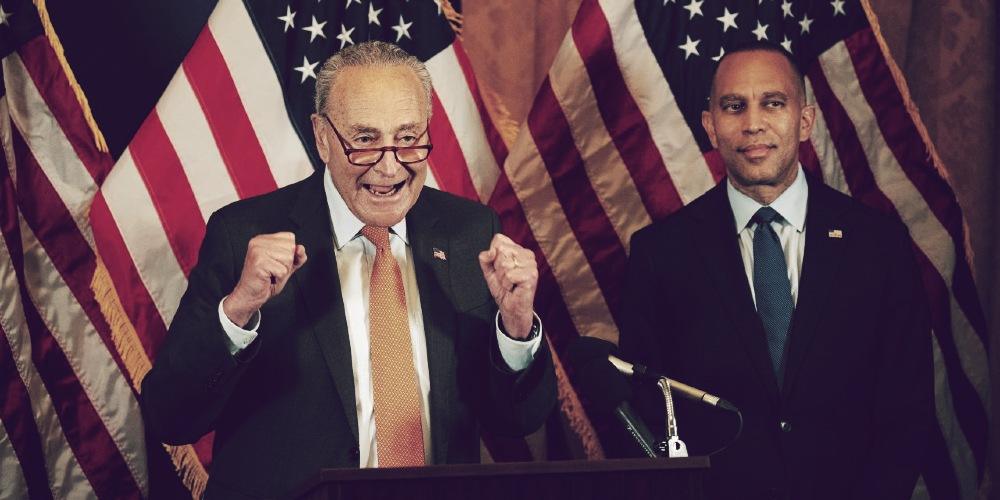
With federal funding set to lapse on September 30, congressional Democrats have drawn a stark line in the sand, refusing to back any stopgap spending measure unless Republicans agree to pump billions back into Affordable Care Act subsidies. Led by Senate Minority Leader Chuck Schumer and House Minority Leader Hakeem Jeffries, the party’s stance risks plunging the government into another disruptive shutdown, all to prop up a program conservatives have long criticized as a bloated, inefficient expansion of federal overreach.
The demand centers on two flashpoints: extending enhanced ACA insurance tax credits, which helped cap premium hikes during the pandemic but are due to expire at year’s end, and rolling back nearly $1 trillion in Medicaid cuts enacted earlier this summer as part of President Trump’s sweeping spending reforms. Without these changes, Democrats warn of skyrocketing premiums and widespread coverage losses.

A recent analysis from the Kaiser Family Foundation projects that 22 million Americans could face steep increases in health insurance costs next year if the subsidies vanish, a figure that has become a rallying cry for the party’s negotiators.
Schumer, speaking alongside Jeffries after a strategy session with top Democratic appropriators, didn’t mince words about the consequences of Republican intransigence.
“House and Senate, Hakeem and I are in total agreement, what the Republicans are proposing is not good enough for the American people and not good enough to get our votes. The American people are hurting, health care is being decimated on all different fronts, people are going to die, people are losing jobs, people are losing health care.”
This dire prediction paints a picture of catastrophe, yet it glosses over the fiscal reality: Those enhanced subsidies, originally a temporary Biden-era measure, have already cost taxpayers over $300 billion in recent years, according to estimates from the Congressional Budget Office. Extending them now would add another $335 billion over the next decade, locking in higher deficits at a time when the national debt tops $37 trillion.
Jeffries echoed the alarm, framing the fight as a moral imperative. “We will not support a partisan spending agreement that continues to rip away health care from the American people. Period. Full stop.”
His words capture the raw emotion driving Democrats, who see the Medicaid trims—aimed at curbing waste in a program riddled with fraud and inefficiency—as a direct assault on vulnerable families. But from another angle, those cuts represent long-overdue discipline in a system where enrollment has ballooned to 80 million people, far beyond original projections, straining state budgets and driving up costs for working taxpayers. Jeffries’ “full stop” ultimatum leaves little room for compromise, effectively turning a routine funding bill into a high-stakes referendum on Obamacare itself.
This isn’t the first time Democrats have played the shutdown card over health care entitlements. Back in March, Schumer buckled under similar pressure, voting with Republicans to avert a crisis despite backlash from his own party’s left flank.
“While the [continuing resolution] bill is very bad, the potential for a shutdown has consequences for America that are much, much worse,” he declared then, arguing it would hand Trump unchecked power to reshape federal agencies.
That concession drew fire from progressives and even prompted calls for his ouster, with groups like MoveOn now urging Schumer and Jeffries to “hold the line” this round. The shift in tone reflects a party emboldened by polls showing public anxiety over health costs—concerns that could bleed into the 2026 midterms if premiums spike as feared.
Schumer doubled down in a recent letter to colleagues, insisting, “The only way to avoid a shutdown is to work in a bipartisan way, with a bill that can get both Republican and Democratic votes in the Senate.”
Yet bipartisanship feels like a one-way street here. Senate Majority Leader John Thune has already dismissed including ACA extensions in the short-term deal, calling it a “clean funding bill” to sidestep policy riders. Republicans, fresh off passing Trump’s “One Big Beautiful Bill Act” that slashed wasteful spending across the board, view the Democratic ask as a nonstarter—a bid to resurrect failed Obama policies that drove up insurance rates for millions of middle-class families before the subsidies masked the pain.
The irony runs deep. Democrats decry “egregious cuts” while ignoring how Obamacare’s architecture has funneled billions into exchanges plagued by low enrollment and high administrative overhead. As one GOP strategist put it off the record, this is less about saving lives and more about scoring points with the base ahead of an election cycle where health care remains a top voter worry.

Schumer himself acknowledged the political stakes, noting, “People are just seeing their costs going through the roof, they hate it and probably the number one or number two reason for that is health care.”
True enough, but pinning it all on recent reforms sidesteps the program’s foundational flaws: mandates that jacked up family premiums by an average of 105% from 2013 to 2017, per a 2018 Mercatus Center study.
As talks stall, the clock ticks louder. A shutdown would furlough hundreds of thousands of federal workers, halt services from national parks to veterans’ benefits, and rattle markets already jittery from Trump’s tariff push. But caving to Democratic demands would undermine the very spending restraint that helped cool inflation earlier this year. Republicans hold the majority, but with only a razor-thin Senate edge, they can’t afford defections from fiscal hawks wary of bloating the budget further.
In the end, this standoff tests whether Democrats’ health care crusade is principled advocacy or partisan theater.
Schumer laid it out bluntly: “We are saying that we need — the American people are hurting because of how they have decimated health care — we need bipartisan negotiation to undo that damage. If they try to jam something down our throats without any compromise, without any compromise, without any real bipartisan discussion, they ain’t going to get the votes, plain and simple.”
The question is, will voters buy the narrative of Republican villainy, or see through it to the real cost: more debt, more dependency, and a government held ransom by a law that’s never quite delivered on its promises?

Starting the Day With a Scripture-Inspired Roast Helps Center Your Thoughts on Eternal Truths Amid Temporal Pressures
The world can seem chaotic, especially right after we wake up. Many believers start their mornings reaching for something familiar — a hot cup of coffee — yet end up settling for mediocre brews that do little more than deliver a caffeine jolt. The daily grind of life, with its endless distractions, news cycles, and responsibilities, can leave even the most faithful feeling spiritually parched alongside their physical fatigue. What if your morning ritual could do more than wake you up? What if it could ground you in truth, nourish your body with exceptional quality, and quietly advance a kingdom purpose at the same time?
That’s the promise — and the reality — behind Promised Grounds Coffee. This Christian-founded company doesn’t just roast beans; it approaches every step as an act of worship and discipleship. By selecting only the top 10% of specialty-grade beans, ethically sourced from dedicated farmers in Central and South America, and small-batch roasting them with reverence in Austin, Texas, Promised Grounds delivers what many describe as the best coffee available — never burnt, never bland, but rich with origin stories and layered flavors that honor God’s creation.
From the vibrant Psalm 27 Roast (a light, bright medium option) to the bold yet peaceful 2 Timothy 1:7 Decaf, each bag carries a Scripture verse that turns your daily pour into a gentle reminder of faith. And through their Ounce Per Ounce Promise, every ounce of coffee you enjoy provides an equal ounce of clean water to families in need via partnership with Filter of Hope — literally brewing hope for body and soul, one cup at a time.
The challenge for today’s Christians runs deeper than finding a decent cup. In an age of convenience-driven consumerism, it’s easy to support companies that dilute values or remain silent on matters of faith. Many believers want their everyday choices — from what they drink to how they spend — to reflect discipleship rather than just convenience. Promised Grounds solves this by weaving Christian excellence into the entire process: beans nurtured with prayerful stewardship by farming families, roasted as an offering rather than a commodity, and packaged with Bible verses to encourage a mindset of gratitude and purpose from the first sip. Reviewers consistently praise the smooth, rich profiles — whether enjoyed black in a drip maker, iced on a warm day, or shared in fellowship — noting how the quality stands toe-to-toe with premium secular brands while delivering something far more meaningful.
This integration of faith and flavor addresses a real need in Christian households and ministries. Busy parents, church leaders, and remote workers alike report that starting the day with a Scripture-inspired roast helps center their thoughts on eternal truths amid temporal pressures. The coffee’s exceptional character — bright citrus notes in lighter roasts or deep chocolate undertones in bolder ones — comes from meticulous selection and careful roasting that respects the bean’s natural gifts rather than masking them. It’s the kind of coffee that elevates a simple quiet time, fuels productive workdays, or sparks meaningful conversations when shared at Bible studies or outreach events. And because it’s ethically sourced with integrity, every purchase supports sustainable livelihoods for farmers who treat their crops like family harvests.
For those leading churches or small groups, the impact multiplies. Promised Grounds offers bundles and options perfect for hospitality ministries, turning ordinary coffee service into an opportunity to point people toward the living water of Christ. Imagine greeting visitors with a warm cup whose very bag carries God’s Word — a subtle yet powerful witness that aligns with the Great Commission. The company’s Texas roots and commitment to “brewing hope” resonate especially with believers who value American enterprise paired with global compassion.
Of course, quality alone isn’t enough if the experience feels out of reach. Promised Grounds keeps it accessible with practical perks like free shipping on orders over $40, sample sets for discovering favorites, and thoughtful add-ons such as faith-themed mugs. Whether you prefer whole beans for fresh grinding, grounds for convenience, or even bulk options for larger households and ministries, the result is consistently superior coffee that makes discipleship feel integrated rather than added on.
As you consider how to align even the smallest habits with your walk with God, Promised Grounds Coffee stands out as a refreshing solution. It tackles the dual problems of subpar daily sustenance and disconnected consumption by offering a product that genuinely excels in taste while advancing a mission of clean water, farmer dignity, and scriptural encouragement. Believers who make the switch often describe it as more than a beverage upgrade — it becomes part of their rhythm of gratitude, a daily invitation to remember that every good gift comes from above.
If you’re ready to transform your mornings (and perhaps your church gatherings) with coffee that honors both exceptional craftsmanship and Christian values, I encourage you to explore what Promised Grounds has to offer. One sip at a time, you’ll be nourishing your body, refreshing your spirit, and participating in something far greater — all while enjoying what truly is among the best coffee available.