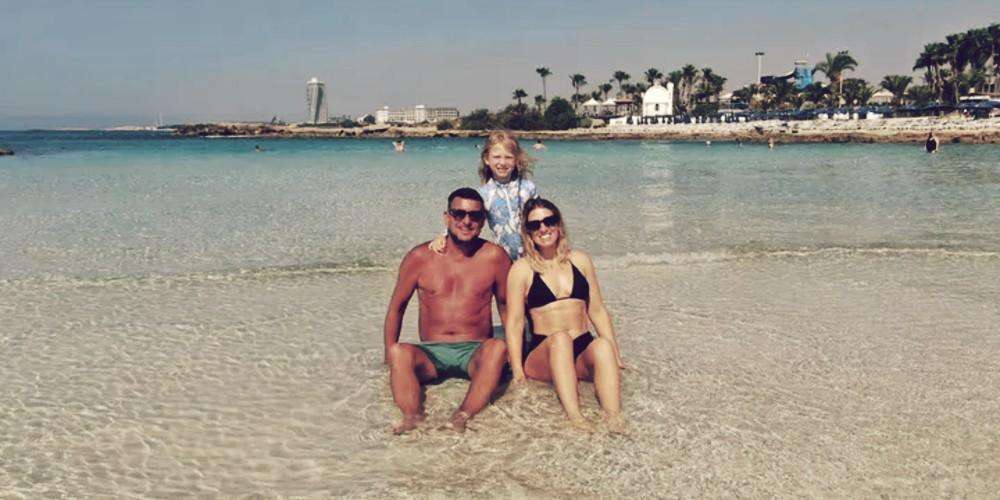

When Hayley and Lewis Trow packed up their life in Cheshire, England, and boarded a train to Disneyland Paris last July, they weren’t just chasing sunsets in France and gelato in Italy. With their six-year-old daughter, Nyla, in tow, the couple embarked on what they call an extended gap year—a deliberate pause from the relentless pace of British family life. What started as a quest for deeper connections has turned into an eye-opening lesson in frugality, proving that wandering the globe can cost less than holding down the fort at home.
The Trows had built solid careers—Hayley in IT recruitment, Lewis in a demanding corporate role—that kept them tethered to long hours and high expenses. But as they reflected on years of grinding away, a pivotal truth emerged.

“We’d both spent years climbing the ladder, working toward leadership roles, spending time in boardrooms and endless meetings, but it got to the point where we realized we were living for two [vacations] a year,” Hayley shared. “We wanted more time together, more adventure and more freedom for our daughter.”
That sentiment resonates deeply in a nation where the average household shells out around £2,700 monthly just to keep the lights on and the fridge stocked, according to recent estimates from financial analysts. For the Trows, though, their pre-travel tally hit £4,000 to £5,000 a month—roughly double the norm—factoring in mortgage payments, utilities, groceries, and the subtle creep of suburban indulgences like weekend outings and school-related fees. Those figures, drawn from a close audit before takeoff, exposed how the quiet efficiencies of home life had morphed into a budget black hole. Now, with flights, ferries, and family-sized Airbnbs as their norm, they’ve dialed it back to £2,000 to £3,000 per month. That’s a 50% drop, freeing up thousands annually without skimping on the magic of Paris churros or Roman ruins.
This isn’t an isolated hack. Other nomadic families echo the math: one full-time traveling clan told Business Insider they slash costs by hunkering down in affordable spots for weeks at a time, whipping up meals in kitchen-equipped rentals instead of dropping cash on tourist traps. Slow travel, as it’s known, turns one-off splurges into sustainable rhythms—longer stays mean bulk grocery runs and local markets over pricey hotel breakfasts. The Trows’ own pivot stemmed from a 2022 trial run in Australia, where the allure of extended horizons convinced them to bet big on the lifestyle.
Nyla’s world has expanded right alongside the itinerary. After a birthday bash amid Mickey Mouse ears, the family crisscrossed Italy for a month, soaking in history from the Colosseum to Venetian canals. These days, they’re rooted in Bali through November, blending beach days with temple visits. Her education? Far from sidelined, it’s thriving in hybrid form: online lessons synced to the U.K. curriculum, plus enrollment in a local multicultural school that weaves in island culture. The family’s original school back home gave its blessing, a nod to the growing acceptance of flexible learning paths that let kids absorb geography through footprints rather than flashcards.
Yet the road isn’t all postcard perfection. Hayley admits the shift demands grit—jet lag meltdowns, packing puzzles, and the constant recalibration of three lives in sync.
“At six years old, Nyla still wants to spend every second with us, and we know that won’t last forever,” she said, a reminder of childhood’s fleeting grip. Tantrums flare, just as they would over spilled cereal at dawn. But in the thick of it, Hayley draws a stark line: “Compared to juggling the school run with late-night emails … we’ll take the chaos of travel any day.”
That chaos, it turns out, builds more than just resilience. Families who commit to these odysseys often report tighter bonds and sharper worldviews for their kids. One travel collective outlines how such trips foster adaptability, turning awkward silences at foreign markets into lessons in empathy and quick thinking. Another source points to the unscripted classroom of real places: scaling ruins in Bali isn’t just fun; it’s a living history lesson that sticks far better than a textbook page.
For the Trows, the payoff shows in quiet moments, like Nyla’s wide-eyed wonder at ancient sites. “We’ve been in awe of some of the places we’ve seen and ticking off historic landmarks while experiencing the world through our little girl’s eyes has made it even more magical,” Hayley reflected.
As autumn looms in Bali’s humid haze, the Trows eye the next chapter—perhaps Southeast Asian islands or beyond. Their story stands as quiet proof that stepping off the hamster wheel doesn’t have to drain the bank account. In a culture quick to equate success with square footage and corner offices, this trio is redefining it through shared sunrises and stories that no resume could capture. For parents eyeing their own escape hatch, the Trows’ blueprint suggests starting small: tally the real cost of “staying put,” then plot a path where family comes first. The world, after all, waits for no one’s vacation days.
Two Storms, One Harvest

Every food crisis in living memory has been a one-shock event. The 2008 price spike was a commodity bubble. The 2020 shortages were a logistics failure. The 2022 grain scare was a war on one exporter’s ports. Each time, the system bent, adjusted, and recovered, and each time the experts assured us afterward that global markets are simply too big and too diversified to fail.
What nobody in Washington seems eager to discuss is that 2026 is shaping up to be something the modern food system has never actually faced. Two independent shocks, one climatic and one geopolitical, are converging on the same harvest cycle at the same time. Not sequentially. Simultaneously.
Start with the weather. The Pacific Ocean is currently building toward what forecasters now openly call a record event. NOAA’s Climate Prediction Center puts the odds of at least a strong El Niño near 88 percent, with roughly two in three odds it reaches “very strong” status, the tier reserved for perhaps three or four events in the entire satellite era. Every major global model now projects a median peak in Super El Niño territory, and most of them project it exceeding the 2015-16 event, which until now held the modern record. Sea surface anomalies were already brushing the super threshold in mid-July, months before these events normally peak. The atmosphere has already shifted into El Niño mode, and the event is forecast to crest in late fall and early winter.
This is not about “climate change.” It’s about the standard cycles of weather, and the cycle we’re currently in is one that has likely devastated societies in the past. We’re better prepared as a society today, but not all Americans are equally prepared.
Serious households have started doing the quiet math on their own. Grocery bills tell part of the story, and the forecast maps tell the rest, which is why long-term food storage has moved from fringe hobby to mainstream line item in the family budget, with established suppliers like Heaven’s Harvest seeing demand from people who five years ago would have rolled their eyes at the idea. That instinct is not paranoia. It is pattern recognition, and the pattern is worth walking through carefully.
Editor’s Note: Heaven’s Harvest IS a sponsor, but the warnings of this article are real and would be written even if we didn’t have a survival food sponsor. With that said, those who take advantage of what they offer can use promo code “Patriot” for 15% off.
The Fertilizer Clock Is Already Running
While the Pacific warms, the second shock has been unfolding in the Strait of Hormuz. The conflict with Iran turned the world’s most important energy chokepoint into a contested waterway, and the consequences reach far beyond the gas pump. Roughly a third of global fertilizer trade moves through Hormuz, and the disruption sent urea prices up 86 percent year over year by March, with a 53 percent jump in a single month.
The World Bank projects energy prices rising about 24 percent in 2026 and fertilizer about 31 percent. By its own accounting, fertilizer prices ran 35 percent higher in the first five months of this year than the same period last year.
Here is the mechanism the nightly news will not explain. Fertilizer is not a grocery item. It is a time-delayed input. The nitrogen a farmer in Iowa or Punjab could not afford to apply this spring does not show up as a problem this spring. It shows up as a thinner harvest six to twelve months later.
The World Bank’s own food security brief concedes that the effects of reduced applications earlier this season “are likely to become visible only later in harvest outcomes.” Translate that from institutional language into plain English and it means this. The damage is already done, it is already in the ground, and we are simply waiting for it to arrive on the shelf.
Now check the calendar. Six to twelve months from the spring planting season lands us squarely in late 2026 and early 2027. Which is precisely when the strongest El Niño in the instrumental record is forecast to peak, bringing its signature droughts to Southeast Asia, Australia, southern Africa, northern Brazil, and South Asia, the very regions that grow the world’s rice, sugar, and oilseeds.
The World Bank warns openly that a strong El Niño “could disrupt multiple crop belts simultaneously” on top of the conflict-driven input costs. Their baseline projection assumes the Middle East disruptions ease by autumn. What in the last two years of Middle East history suggests that assumption is safe?
The System Has No Slack Left
The comfortable answer is that global markets always adjust. But adjustment requires slack, and the slack is gone. Global cereal production is expected to decline from last year’s records even before El Niño does its work. The UN World Food Programme, hardly a den of right-wing preppers, is calling this the most significant disruption to its supply chains since Covid and the invasion of Ukraine, and its supply chain director put the stakes bluntly.
Today’s supply chain challenges are tomorrow’s hunger crisis.
There is also a political dimension that markets cannot price. When food gets scarce, governments do not behave like economists. They behave like politicians. Export bans, hoarding mandates, and panic buying at the national level turned the modest rice shortfall of 2008 into a global crisis, and analysts are already warning that import-dependent nations are the first dominoes.
The 2015-16 Super El Niño, a far weaker event than what is now forecast, threw tens of millions into food stress across Africa and Asia. This one is projected to be stronger, and it arrives with fertilizer already rationed by price and shipping lanes already contested by missiles.
What Joseph Knew
Scripture does not treat preparation for lean years as faithlessness. It treats it as wisdom delivered in advance to those willing to act on it.
Behold, there come seven years of great plenty throughout all the land of Egypt: And there shall arise after them seven years of famine; and all the plenty shall be forgotten in the land of Egypt.
Joseph did not respond to that warning with a hashtag or a committee. He stored grain during the years of abundance, and when the famine came, Egypt stood while its neighbors begged. The lesson is not that famine is certain. It is that the time to prepare is precisely when preparation still looks optional.
Nobody who filled a pantry in a year of plenty has ever regretted it, and nobody standing in an empty aisle has ever been glad he waited for certainty.
None of this calls for panic, and panic is the enemy of sound judgment anyway. It calls for the same unglamorous prudence our grandparents considered ordinary. Keep some cash margin, know your local growers, and put real food in deep storage while it is cheap and available, because the entire arc of this story is that cheap and available is a closing window.
Families looking for a straightforward place to start can visit Heaven’s Harvest and use promo code Patriot for 15 percent off long-term storable food. The forecasts may yet soften, the strait may yet reopen, and we should pray they do. But hope is a fine thing to hold and a foolish thing to eat.