
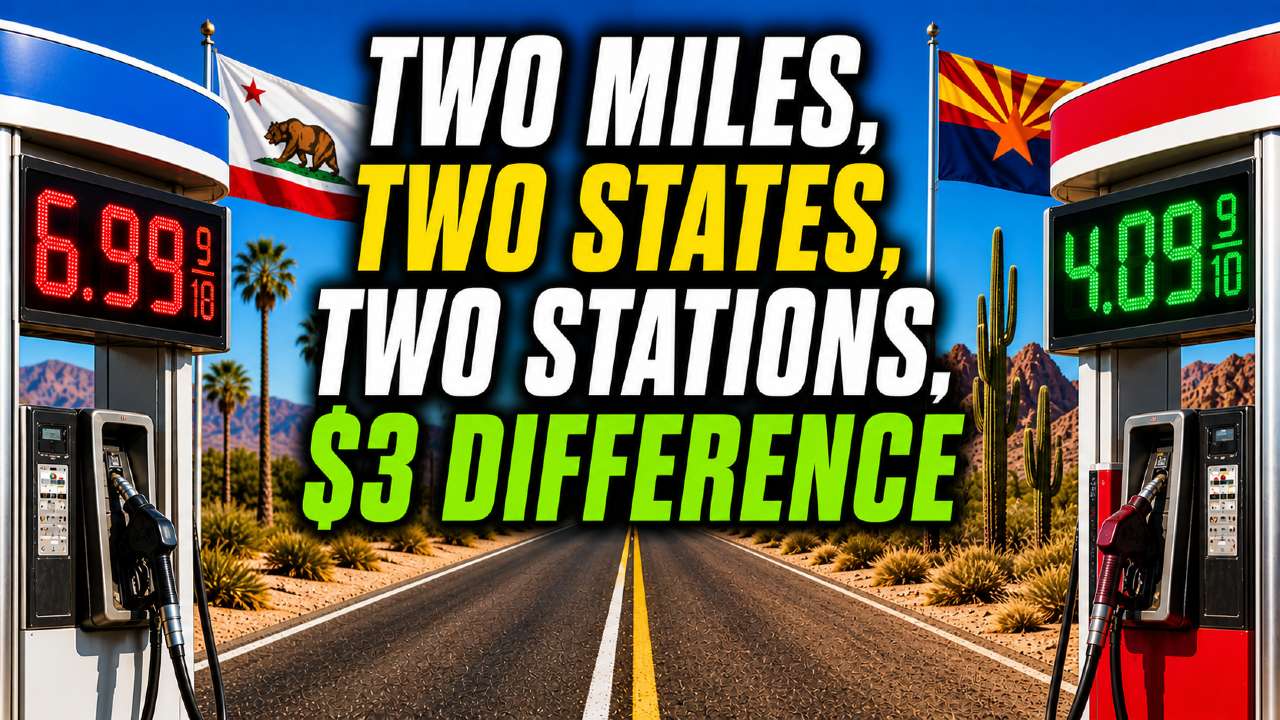
Just across the Colorado River, two gas stations stand 1.8 miles apart, yet they inhabit different economic universes. In Needles, California, manager Cody Eggleston tends an eerily empty Mobil station where regular unleaded commands a punishing $6.99 per gallon. Drive over the K Street Bridge into Arizona, and the same fuel flows for $4.09. This is not market magic or corporate conspiracy. It is the predictable fruit of Sacramento’s relentless war on affordable energy.
California’s highest-in-the-nation gas tax of 61 cents per gallon, layered atop 34 to 44 cents in emissions and climate fees, has turned routine fill-ups into a luxury. Fed-up drivers vote with their wheels, crossing state lines to save nearly three dollars on every gallon. The result is a stark portrait of policy failure: empty forecourts in the Golden State, bustling pumps in the Grand Canyon State, and working families squeezed hardest by the very leaders who promise to protect them.

Cody Eggleston, a 28-year-old father of two who also works as a mechanic, remembers better days on historic Route 66. Travelers streaming out of California once stopped reliably. Now they speed past, bound for Lake Havasu or the Grand Canyon, wallets intact. “We used to get a lot of traffic,” he said. “Anybody coming out of California, every single person would stop here.” Those days are gone. Even Needles residents commute across the river for fuel.
The numbers tell the story without embellishment. From January through late April this year, the station moved just 78,000 gallons. Full-year 2025 saw 305,000; 2024 managed 426,000. Business has been cut in half as drivers refuse to subsidize Sacramento’s green dreams. A sign in the station window lays out the tax burden, a quiet indictment of the policies driving customers away.
Across the bridge in Mohave Valley, Arizona, the scene flips. At the local Arco, caregiver Samantha Walsh filled her tank before heading back to Apple Valley, California. Minimum-wage work makes every dollar count. “You save two or three more dollars,” she noted. “There’s a difference for sure.” Raven Carpenter, a married mother of two and zookeeper, echoed the sentiment: she budgets carefully for her long commute and refuses to pay California prices. “I couldn’t imagine having to pay” them.
Rep. Vince Fong cut through the noise: Californians are “overtaxed and overregulated” at the pump. Gavin Newsom’s energy mandates, refinery closures, and climate programs have manufactured this crisis. The consequences fall on working families who must drive to earn a living. Arizona station owner Paul Sun sees the steady stream from California. His customers are simply glad he is there.
Steve Hilton, a Republican candidate for California governor, captured the irony. Progressive climate policies punish the very people they claim to champion while doing nothing measurable for global temperatures. Regular workers driving hours daily bear the brunt in the name of a “climate religion” that exports emissions across borders rather than reducing them. Every Democratic contender for governor remains locked into the same goals that produced these prices.
This border parable fits a larger pattern. California has hemorrhaged residents and businesses seeking relief from crushing costs. High housing prices, energy mandates, and regulatory overload accelerate the flight. Arizona and other neighboring states reap the benefits while Sacramento doubles down. Even some Democrats, like San Jose Mayor Matt Mahan running for governor, now call for temporary gas tax suspensions, acknowledging the pain ordinary families endure.
Yet temporary fixes paper over the deeper issue. When government piles on taxes, fees, and rules that shutter refineries and inflate every gallon, the market responds. People adapt. They cross bridges, change routes, or leave altogether. The loneliest gas station attendant in Needles stands as a living witness to what happens when ideology overrides reality.
As Scripture warns in Hosea 4:6, “My people are destroyed for lack of knowledge.” Californians need not remain ignorant of how policies crafted in air-conditioned capitals translate into empty pumps and strained budgets. Wisdom demands recognizing the connection between governance and daily life. Rejecting the failed experiments that burden families while enriching government coffers is not radical. It is responsible stewardship of the resources God has given.
The bridge between Needles and Arizona is short. The distance between Sacramento’s vision and working families’ reality grows wider by the day. Until leaders choose affordable energy over symbolic virtue, more stations will stand empty, more drivers will cross borders, and more Californians will wonder why opportunity feels so close yet remains out of reach.
Starting the Day With a Scripture-Inspired Roast Helps Center Your Thoughts on Eternal Truths Amid Temporal Pressures
The world can seem chaotic, especially right after we wake up. Many believers start their mornings reaching for something familiar — a hot cup of coffee — yet end up settling for mediocre brews that do little more than deliver a caffeine jolt. The daily grind of life, with its endless distractions, news cycles, and responsibilities, can leave even the most faithful feeling spiritually parched alongside their physical fatigue. What if your morning ritual could do more than wake you up? What if it could ground you in truth, nourish your body with exceptional quality, and quietly advance a kingdom purpose at the same time?
That’s the promise — and the reality — behind Promised Grounds Coffee. This Christian-founded company doesn’t just roast beans; it approaches every step as an act of worship and discipleship. By selecting only the top 10% of specialty-grade beans, ethically sourced from dedicated farmers in Central and South America, and small-batch roasting them with reverence in Austin, Texas, Promised Grounds delivers what many describe as the best coffee available — never burnt, never bland, but rich with origin stories and layered flavors that honor God’s creation.
From the vibrant Psalm 27 Roast (a light, bright medium option) to the bold yet peaceful 2 Timothy 1:7 Decaf, each bag carries a Scripture verse that turns your daily pour into a gentle reminder of faith. And through their Ounce Per Ounce Promise, every ounce of coffee you enjoy provides an equal ounce of clean water to families in need via partnership with Filter of Hope — literally brewing hope for body and soul, one cup at a time.
The challenge for today’s Christians runs deeper than finding a decent cup. In an age of convenience-driven consumerism, it’s easy to support companies that dilute values or remain silent on matters of faith. Many believers want their everyday choices — from what they drink to how they spend — to reflect discipleship rather than just convenience. Promised Grounds solves this by weaving Christian excellence into the entire process: beans nurtured with prayerful stewardship by farming families, roasted as an offering rather than a commodity, and packaged with Bible verses to encourage a mindset of gratitude and purpose from the first sip. Reviewers consistently praise the smooth, rich profiles — whether enjoyed black in a drip maker, iced on a warm day, or shared in fellowship — noting how the quality stands toe-to-toe with premium secular brands while delivering something far more meaningful.
This integration of faith and flavor addresses a real need in Christian households and ministries. Busy parents, church leaders, and remote workers alike report that starting the day with a Scripture-inspired roast helps center their thoughts on eternal truths amid temporal pressures. The coffee’s exceptional character — bright citrus notes in lighter roasts or deep chocolate undertones in bolder ones — comes from meticulous selection and careful roasting that respects the bean’s natural gifts rather than masking them. It’s the kind of coffee that elevates a simple quiet time, fuels productive workdays, or sparks meaningful conversations when shared at Bible studies or outreach events. And because it’s ethically sourced with integrity, every purchase supports sustainable livelihoods for farmers who treat their crops like family harvests.
For those leading churches or small groups, the impact multiplies. Promised Grounds offers bundles and options perfect for hospitality ministries, turning ordinary coffee service into an opportunity to point people toward the living water of Christ. Imagine greeting visitors with a warm cup whose very bag carries God’s Word — a subtle yet powerful witness that aligns with the Great Commission. The company’s Texas roots and commitment to “brewing hope” resonate especially with believers who value American enterprise paired with global compassion.
Of course, quality alone isn’t enough if the experience feels out of reach. Promised Grounds keeps it accessible with practical perks like free shipping on orders over $40, sample sets for discovering favorites, and thoughtful add-ons such as faith-themed mugs. Whether you prefer whole beans for fresh grinding, grounds for convenience, or even bulk options for larger households and ministries, the result is consistently superior coffee that makes discipleship feel integrated rather than added on.
As you consider how to align even the smallest habits with your walk with God, Promised Grounds Coffee stands out as a refreshing solution. It tackles the dual problems of subpar daily sustenance and disconnected consumption by offering a product that genuinely excels in taste while advancing a mission of clean water, farmer dignity, and scriptural encouragement. Believers who make the switch often describe it as more than a beverage upgrade — it becomes part of their rhythm of gratitude, a daily invitation to remember that every good gift comes from above.
If you’re ready to transform your mornings (and perhaps your church gatherings) with coffee that honors both exceptional craftsmanship and Christian values, I encourage you to explore what Promised Grounds has to offer. One sip at a time, you’ll be nourishing your body, refreshing your spirit, and participating in something far greater — all while enjoying what truly is among the best coffee available.