
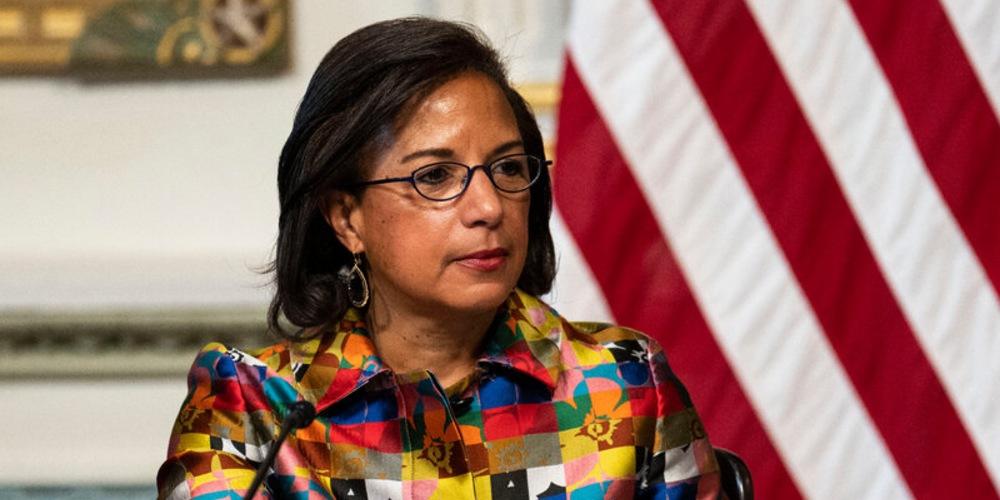
Netflix is learning the hard way that the era of “cost-free” political activism by corporate elites may be over, especially when that activism involves open threats against supporters of a sitting president. After former Obama and Biden official Susan Rice used a podcast appearance to warn that companies which “bent the knee” to President Donald Trump would face an “accountability agenda” under a future Democrat administration, Netflix chose to stand by her — and watched its stock take a hit as investors digested the political and regulatory risk that decision carries.
The controversy began with Rice’s appearance on Preet Bharara’s “Stay Tuned” podcast, where she made it clear that, in her view, corporate America should expect retribution if Democrats return to power. She said it was “not going to end well” for corporations, news organizations, and law firms that “bent the knee” to Trump, doubling down that this would not be a case of “forgive and forget.”

She added that these institutions have “another thing coming” and that Democrats “have had a bellyful” and are “not going to play by the old set of rules.” Coming from a former national security adviser and domestic policy chief who still sits on Netflix’s board, those comments sounded less like idle chatter and more like a promise.
President Trump responded in kind, using his Truth Social account to call on Netflix to fire Rice “IMMEDIATELY, or pay the consequences.” He blasted her as “racist, Trump Deranged,” said she has “no talent or skills – Purely a political hack,” and questioned how much she is being paid “and for what.”
This was not a stray outburst in a slow news cycle; it landed in the middle of a massive, politically sensitive media merger fight in which Netflix needs cooperation from the same administration Rice wants to see punished, and from the same Justice Department Trump now directs.
At stake is Netflix’s roughly $72 billion bid to acquire Warner Bros. Discovery, a deal that requires antitrust approval from the Department of Justice and that is already drawing scrutiny over potential harms to competition and creative talent. Regulators are examining whether Netflix’s previous acquisitions and negotiating tactics with independent creators show a pattern of anticompetitive behavior. Meanwhile, rival Paramount Skydance has launched a hostile bid to take over all of Warner Bros. Discovery, offering shareholders a rich cash payout and presenting itself as the cleaner, less politically entangled suitor.
In that context, Rice’s rhetoric plays very differently from a standard partisan jab. She framed her position as a warning that media companies, law firms, universities, and corporate interests that sided with Trump for short-term gain will be “held accountable” when Democrats regain power — explicitly rejecting the idea that there will be a return to “old rules” or a willingness to “forgive and forget.”
For millions of Trump voters and the officials who serve them, that sounds like a threat of politicized retaliation, not just a policy disagreement, especially coming from a power player who has rotated between Democrat administrations and top corporate boards for years.
Investors noticed. Netflix’s shares opened down sharply and closed the day notably lower, as markets processed not only the merger uncertainties but the very public clash between the president and a Netflix board member whose comments invite questions about weaponized politics inside elite institutions. It is impossible to assign a precise percentage of that decline to the Rice controversy alone, especially with a giant acquisition on the table, but at minimum the episode added a fresh layer of political risk at a critical moment. In a world where regulatory decisions can swing tens of billions of dollars in market value, executives and shareholders ignore that sort of risk at their peril.
This aligns with their current trajectory with the stock down nearly 38% over the last six months.
Netflix co-CEO Ted Sarandos has, so far, decided to ride out the storm. In a recent interview, he rejected calls to remove Rice and insisted the Warner Bros. Discovery deal is “a business deal, not a political deal,” brushing off Trump’s social media warning as something the president “likes to do” online. He added that it should be regulators, not the White House, who decide the fate of the merger. That answer fits the civics-textbook version of how the system should function — but it also assumes a clean separation between politics and enforcement that no longer exists on either side of the aisle.
There are several layers here that matter beyond Netflix’s ticker symbol. First, Rice’s comments openly endorse a future in which Democrats use institutional power — corporate, legal, academic, and media — to punish anyone who cooperated with Trump. Second, Netflix’s decision to keep her on the board in the middle of a mega-merger that depends on goodwill from the Trump administration tells investors that the company is willing to stake shareholder value on a particular brand of hardline partisan politics. Third, a sitting president threatening “consequences” for a specific corporation if it does not fire a political enemy sends its own message to every CEO in America: personnel decisions that once lived inside the boardroom now live inside the political arena.
For years, conservatives have warned that the merger of ideological activism and corporate governance would eventually collide with reality. When a board member with deep ties to the Democrat establishment publicly promises that her side will “hold accountable” companies that ever “took a knee” to Trump, she is admitting what many on the right have long suspected: that the left’s project is not simply to win elections, but to control the levers of culture, law, and capital — and to make dissent costly. When a president who has already seen how the administrative state can be aimed at him now has the formal authority to approve or block a deal central to Netflix’s future, investors have to decide whether a company doubling down on that board member is acting in their best interest or making them collateral damage in an ideological war.
Netflix may yet get its Warner Bros. Discovery deal approved, and the stock may recover as traders move on to the next crisis. But this episode should force a broader reckoning: when publicly traded companies elevate political operatives who openly fantasize about punishing half the country, they are not just making a “values” statement. They are writing a check on shareholder capital, betting that their preferred faction will ultimately control the guns of government and the gates of culture. In the Trump era, that bet suddenly looks a lot more dangerous — and investors just sent Netflix an early warning that the days of cost-free corporate wokeness may be ending.
Starting the Day With a Scripture-Inspired Roast Helps Center Your Thoughts on Eternal Truths Amid Temporal Pressures
The world can seem chaotic, especially right after we wake up. Many believers start their mornings reaching for something familiar — a hot cup of coffee — yet end up settling for mediocre brews that do little more than deliver a caffeine jolt. The daily grind of life, with its endless distractions, news cycles, and responsibilities, can leave even the most faithful feeling spiritually parched alongside their physical fatigue. What if your morning ritual could do more than wake you up? What if it could ground you in truth, nourish your body with exceptional quality, and quietly advance a kingdom purpose at the same time?
That’s the promise — and the reality — behind Promised Grounds Coffee. This Christian-founded company doesn’t just roast beans; it approaches every step as an act of worship and discipleship. By selecting only the top 10% of specialty-grade beans, ethically sourced from dedicated farmers in Central and South America, and small-batch roasting them with reverence in Austin, Texas, Promised Grounds delivers what many describe as the best coffee available — never burnt, never bland, but rich with origin stories and layered flavors that honor God’s creation.
From the vibrant Psalm 27 Roast (a light, bright medium option) to the bold yet peaceful 2 Timothy 1:7 Decaf, each bag carries a Scripture verse that turns your daily pour into a gentle reminder of faith. And through their Ounce Per Ounce Promise, every ounce of coffee you enjoy provides an equal ounce of clean water to families in need via partnership with Filter of Hope — literally brewing hope for body and soul, one cup at a time.
The challenge for today’s Christians runs deeper than finding a decent cup. In an age of convenience-driven consumerism, it’s easy to support companies that dilute values or remain silent on matters of faith. Many believers want their everyday choices — from what they drink to how they spend — to reflect discipleship rather than just convenience. Promised Grounds solves this by weaving Christian excellence into the entire process: beans nurtured with prayerful stewardship by farming families, roasted as an offering rather than a commodity, and packaged with Bible verses to encourage a mindset of gratitude and purpose from the first sip. Reviewers consistently praise the smooth, rich profiles — whether enjoyed black in a drip maker, iced on a warm day, or shared in fellowship — noting how the quality stands toe-to-toe with premium secular brands while delivering something far more meaningful.
This integration of faith and flavor addresses a real need in Christian households and ministries. Busy parents, church leaders, and remote workers alike report that starting the day with a Scripture-inspired roast helps center their thoughts on eternal truths amid temporal pressures. The coffee’s exceptional character — bright citrus notes in lighter roasts or deep chocolate undertones in bolder ones — comes from meticulous selection and careful roasting that respects the bean’s natural gifts rather than masking them. It’s the kind of coffee that elevates a simple quiet time, fuels productive workdays, or sparks meaningful conversations when shared at Bible studies or outreach events. And because it’s ethically sourced with integrity, every purchase supports sustainable livelihoods for farmers who treat their crops like family harvests.
For those leading churches or small groups, the impact multiplies. Promised Grounds offers bundles and options perfect for hospitality ministries, turning ordinary coffee service into an opportunity to point people toward the living water of Christ. Imagine greeting visitors with a warm cup whose very bag carries God’s Word — a subtle yet powerful witness that aligns with the Great Commission. The company’s Texas roots and commitment to “brewing hope” resonate especially with believers who value American enterprise paired with global compassion.
Of course, quality alone isn’t enough if the experience feels out of reach. Promised Grounds keeps it accessible with practical perks like free shipping on orders over $40, sample sets for discovering favorites, and thoughtful add-ons such as faith-themed mugs. Whether you prefer whole beans for fresh grinding, grounds for convenience, or even bulk options for larger households and ministries, the result is consistently superior coffee that makes discipleship feel integrated rather than added on.
As you consider how to align even the smallest habits with your walk with God, Promised Grounds Coffee stands out as a refreshing solution. It tackles the dual problems of subpar daily sustenance and disconnected consumption by offering a product that genuinely excels in taste while advancing a mission of clean water, farmer dignity, and scriptural encouragement. Believers who make the switch often describe it as more than a beverage upgrade — it becomes part of their rhythm of gratitude, a daily invitation to remember that every good gift comes from above.
If you’re ready to transform your mornings (and perhaps your church gatherings) with coffee that honors both exceptional craftsmanship and Christian values, I encourage you to explore what Promised Grounds has to offer. One sip at a time, you’ll be nourishing your body, refreshing your spirit, and participating in something far greater — all while enjoying what truly is among the best coffee available.