(The Economic Collapse Blog)—Why are social media platforms filled with videos of Americans complaining about grocery prices right now? Needless to say, those videos must be striking a chord, because some of them are receiving millions of views. Government bureaucrats are telling us that the cost of food is only going up a few percentage points per year, but we can all see that is a load of nonsense. A trip to the grocery store has become an enormous expense, and this is especially true if you have kids to feed. As I wrote about earlier this month, one survey found that in 25 percent of U.S. households at least one person is skipping meals so that there will be enough money to pay the bills. Sadly, we are being warned that the cost of groceries will go even higher in the months ahead.
Several years ago, I kept warning my readers over and over again that soon the cost of groceries would become very painful.

Without a doubt, that time has arrived.
According to a recent AP poll, the cost of groceries is a “source of stress” for 86 percent of U.S. adults…
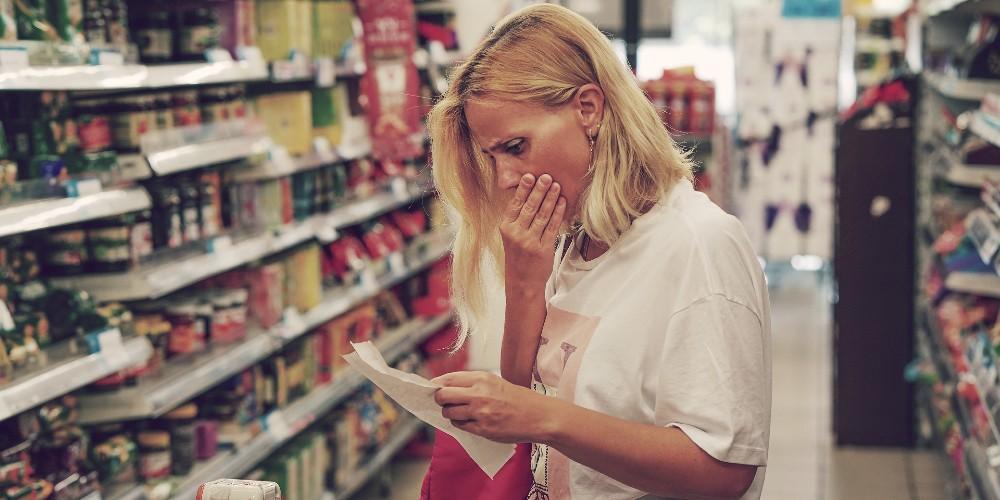
Does your run to the supermarket cause a spike in your blood pressure? You’re in good company.
The overwhelming majority of Americans – 86% – say the cost of groceries is at least a minor source of stress. The number includes 53% who say it’s a major source of anxiety in their lives right now. That’s according to a new Associated Press/NORC poll.
Those are very alarming numbers.
But this is the world that we live in now.
And this is why we are seeing so many videos on social media about grocery prices.
Someone put together a compilation of some of the best videos where people are really flipping out emotionally…
In my entire lifetime, I have never seen it so bad.
At one grocery store in Chicago, one woman admitted that it feels like “you’re spending your soul on groceries”…
At a South Loop grocery store, customers experience sticker shock and frustration.
“No matter if it’s organic or if it’s regular, it’s still going to be an arm and a leg for it. It’s like you’re spending your soul on groceries,” said shopper Tria Hutson.
This is one of the reasons why I get so frustrated with the talking heads on television that are telling us that everything is fine.
Just look around you.
People are hurting.
Some companies are trying to hide their price hikes by keeping the prices the same but putting less stuff in each package.

This is known as “shinkflation”, and Jim Quinn recently shared a personal anecdote from his own life…
I think a personal anecdote I’ve experienced will show you the devious methods corporations will use to pass these tariffs along. I have been buying a pack of coated paper plates at Wal-Mart for years. The pack contained 70 paper plates. Within the last four months, the pack was reduced to 50 plates, for the same price. They know the average dolt, after years of government schooling, is deficient in math skills, so they would not realize they just experienced a 40% increase in price per plate. This will show up nowhere in the fake BLS numbers. Shrinkflation is just as bad as inflation, but they can hide it and pretend all is well, while maintaining their profits.
I am sure that you are running into the same thing.
Unfortunately, this is just the beginning.
How can I be so confident in saying that?
Let me give you just one example.
Approximately two-thirds of U.S. adults drink coffee, and approximately one-third of all the coffee we drink comes from Brazil.

Thanks to the 50 percent tariff that was just placed on imports from Brazil, coffee is about to become a lot more expensive…
The U.S. relies heavily on Brazil to import coffee for the 165 million people who need their daily caffeine fix, but Trump’s 50 percent tariff threatens the long-term availability and price of the drink.
“When people go to their local coffee shop, whether it’s Starbucks or something else, by and large they will likely be buying some form of Brazilian coffee,” Monica de Bolle, senior fellow at the Peterson Institute for International Economics, told NPR.
“A 50 percent tariff will kill that market.”
I still remember the days when you could get a cup of coffee for 10 cents.
What did your latest cup of coffee cost you?
Of course everything else is becoming more expensive too, and our cost of living crisis never seems to end.
As a result, 62 percent of Gen Z Americans have no emergency savings at all…
- 62% of Gen Z have no emergency savings, nearly double the rate of baby boomers.
- 51% of Americans would use a credit card for a $500 emergency, with usage jumping to 70% among students.
- Two-thirds of consumers have six months or less in savings, with Gen X the least prepared.
- 76% lack a credit card set aside for emergencies, relying instead on everyday-use cards.
Most of the country is living on the edge financially.
The middle class is steadily shrinking, and those that remain in the middle class have much less discretionary income than they once did.
So restaurants all over the nation find themselves torn between rapidly rising costs and customers that now have a lot less money to spend…
Ike’s Chili in Tulsa, Oklahoma, has been around for 117 years, surviving a myriad of challenges like the Great Depression, the Covid-19 pandemic and a once-in-a-generation burst of inflation. But 2025 already holds an even more complicated challenge.
“The cost of everything’s just going up, and we’ve got to figure out how to manage it right,” Len Wade, a managing partner at the restaurant, told CNN.
He pointed to surging beef prices as an example, specifically hamburger meat on the wholesale level. In July, those prices were up nearly 21% compared to the same month 10 years ago, federal data shows. And passing the buck to customers might not be the best solution, Wade said.
Tourist destinations from coast to coast are experiencing the same thing.
Las Vegas is getting far less tourist traffic than it once did, and those that do arrive are tipping a lot less…
Las Vegas servers say they’re feeling the heat as high prices and declining tourism hammer their tip earnings across the Strip.
Tipping in Sin City is reportedly down by as much as 50% among servers, as some of them blame the economy and policy while others point to high prices, a tipping backlash and poor service.
On Reddit’s r/VegasLocals forum, one cocktail waitress wrote, “I used to average about 80 cents a drink. Now I’m averaging about 10 cents.”
Nobody can deny what is happening.
We really are experiencing a very serious economic crisis.
Sticking our heads in the sand and pretending that everything is okay is not going to fix anything.
Our standard of living really is collapsing, and a lot more pain is ahead as our economic bubbles continue to burst.
We were warned that this storm was coming for a long time, and now it is here.
Michael’s new book entitled “10 Prophetic Events That Are Coming Next” is available in paperback and for the Kindle on Amazon.com, and you can subscribe to his Substack newsletter at michaeltsnyder.substack.com.
Two Storms, One Harvest

Every food crisis in living memory has been a one-shock event. The 2008 price spike was a commodity bubble. The 2020 shortages were a logistics failure. The 2022 grain scare was a war on one exporter’s ports. Each time, the system bent, adjusted, and recovered, and each time the experts assured us afterward that global markets are simply too big and too diversified to fail.
What nobody in Washington seems eager to discuss is that 2026 is shaping up to be something the modern food system has never actually faced. Two independent shocks, one climatic and one geopolitical, are converging on the same harvest cycle at the same time. Not sequentially. Simultaneously.
Start with the weather. The Pacific Ocean is currently building toward what forecasters now openly call a record event. NOAA’s Climate Prediction Center puts the odds of at least a strong El Niño near 88 percent, with roughly two in three odds it reaches “very strong” status, the tier reserved for perhaps three or four events in the entire satellite era. Every major global model now projects a median peak in Super El Niño territory, and most of them project it exceeding the 2015-16 event, which until now held the modern record. Sea surface anomalies were already brushing the super threshold in mid-July, months before these events normally peak. The atmosphere has already shifted into El Niño mode, and the event is forecast to crest in late fall and early winter.
This is not about “climate change.” It’s about the standard cycles of weather, and the cycle we’re currently in is one that has likely devastated societies in the past. We’re better prepared as a society today, but not all Americans are equally prepared.
Serious households have started doing the quiet math on their own. Grocery bills tell part of the story, and the forecast maps tell the rest, which is why long-term food storage has moved from fringe hobby to mainstream line item in the family budget, with established suppliers like Heaven’s Harvest seeing demand from people who five years ago would have rolled their eyes at the idea. That instinct is not paranoia. It is pattern recognition, and the pattern is worth walking through carefully.
Editor’s Note: Heaven’s Harvest IS a sponsor, but the warnings of this article are real and would be written even if we didn’t have a survival food sponsor. With that said, those who take advantage of what they offer can use promo code “Patriot” for 15% off.
The Fertilizer Clock Is Already Running
While the Pacific warms, the second shock has been unfolding in the Strait of Hormuz. The conflict with Iran turned the world’s most important energy chokepoint into a contested waterway, and the consequences reach far beyond the gas pump. Roughly a third of global fertilizer trade moves through Hormuz, and the disruption sent urea prices up 86 percent year over year by March, with a 53 percent jump in a single month.
The World Bank projects energy prices rising about 24 percent in 2026 and fertilizer about 31 percent. By its own accounting, fertilizer prices ran 35 percent higher in the first five months of this year than the same period last year.
Here is the mechanism the nightly news will not explain. Fertilizer is not a grocery item. It is a time-delayed input. The nitrogen a farmer in Iowa or Punjab could not afford to apply this spring does not show up as a problem this spring. It shows up as a thinner harvest six to twelve months later.
The World Bank’s own food security brief concedes that the effects of reduced applications earlier this season “are likely to become visible only later in harvest outcomes.” Translate that from institutional language into plain English and it means this. The damage is already done, it is already in the ground, and we are simply waiting for it to arrive on the shelf.
Now check the calendar. Six to twelve months from the spring planting season lands us squarely in late 2026 and early 2027. Which is precisely when the strongest El Niño in the instrumental record is forecast to peak, bringing its signature droughts to Southeast Asia, Australia, southern Africa, northern Brazil, and South Asia, the very regions that grow the world’s rice, sugar, and oilseeds.
The World Bank warns openly that a strong El Niño “could disrupt multiple crop belts simultaneously” on top of the conflict-driven input costs. Their baseline projection assumes the Middle East disruptions ease by autumn. What in the last two years of Middle East history suggests that assumption is safe?
The System Has No Slack Left
The comfortable answer is that global markets always adjust. But adjustment requires slack, and the slack is gone. Global cereal production is expected to decline from last year’s records even before El Niño does its work. The UN World Food Programme, hardly a den of right-wing preppers, is calling this the most significant disruption to its supply chains since Covid and the invasion of Ukraine, and its supply chain director put the stakes bluntly.
Today’s supply chain challenges are tomorrow’s hunger crisis.
There is also a political dimension that markets cannot price. When food gets scarce, governments do not behave like economists. They behave like politicians. Export bans, hoarding mandates, and panic buying at the national level turned the modest rice shortfall of 2008 into a global crisis, and analysts are already warning that import-dependent nations are the first dominoes.
The 2015-16 Super El Niño, a far weaker event than what is now forecast, threw tens of millions into food stress across Africa and Asia. This one is projected to be stronger, and it arrives with fertilizer already rationed by price and shipping lanes already contested by missiles.
What Joseph Knew
Scripture does not treat preparation for lean years as faithlessness. It treats it as wisdom delivered in advance to those willing to act on it.
Behold, there come seven years of great plenty throughout all the land of Egypt: And there shall arise after them seven years of famine; and all the plenty shall be forgotten in the land of Egypt.
Joseph did not respond to that warning with a hashtag or a committee. He stored grain during the years of abundance, and when the famine came, Egypt stood while its neighbors begged. The lesson is not that famine is certain. It is that the time to prepare is precisely when preparation still looks optional.
Nobody who filled a pantry in a year of plenty has ever regretted it, and nobody standing in an empty aisle has ever been glad he waited for certainty.
None of this calls for panic, and panic is the enemy of sound judgment anyway. It calls for the same unglamorous prudence our grandparents considered ordinary. Keep some cash margin, know your local growers, and put real food in deep storage while it is cheap and available, because the entire arc of this story is that cheap and available is a closing window.
Families looking for a straightforward place to start can visit Heaven’s Harvest and use promo code Patriot for 15 percent off long-term storable food. The forecasts may yet soften, the strait may yet reopen, and we should pray they do. But hope is a fine thing to hold and a foolish thing to eat.