
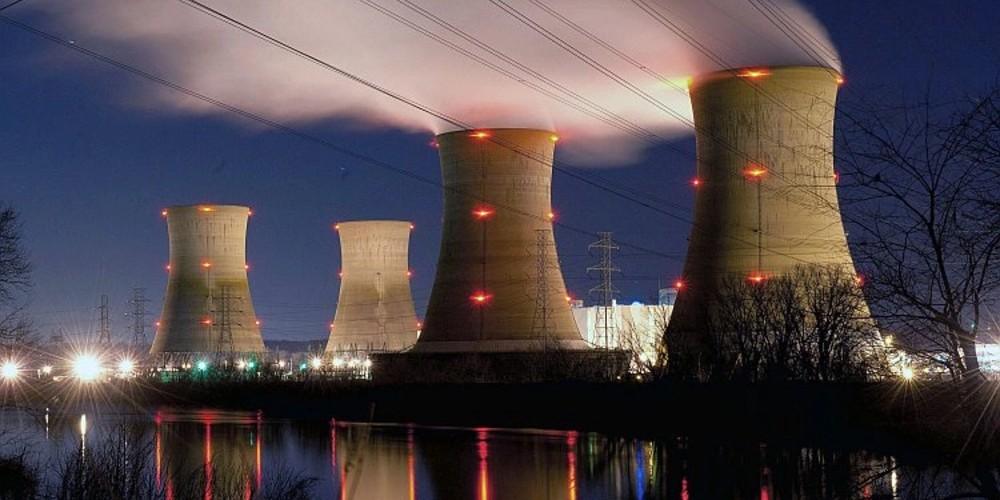
(The Epoch Times)—The Department of Energy (DOE) has invested billions in incentivizing domestic production of enriched uranium for the commercial development of advanced nuclear reactors, including $2.7 billion issued last month to three companies to build centrifuges and processing plants necessary to produce fuel for reactor cores.
Yet, a fuel crunch that could hobble President Donald Trump’s “nuclear renaissance” initiatives looms as soon as 2028, several experts warned during the two-day U.S. Nuclear Industry Council’s 13th annual Advanced Reactors Summit in Seattle that concluded Feb. 12.

“If America wants to lead in advanced reactors, we have to do the nuclear fuel here. Make no mistake about that,” Centrus Energy Senior Vice President Patrick Brown told more than 400 nuclear industry professionals on Feb.12.
“Unfortunately, we’re really building from zero.”
Right now, he said, less than 1 percent of the nuclear fuel that the nation’s 94 commercial reactors annually consume is produced domestically, and that is exclusively dedicated to the Pentagon. The nation’s commercial nuclear energy industry is “completely reliant on foreign imports” of enriched uranium, he said, primarily from Kazakhstan and Canada.
Those imports include up to 5 percent from Russia that won’t be available soon. In response to Russia’s invasion of Ukraine in 2022, Congress in 2023 banned U.S. companies from importing Russian uranium. That ban goes into effect on Jan. 1, 2028.
Brown said with the global nuclear fuel market already constrained, domestic industry’s scramble to revive enrichment—a process American companies invented and once dominated—is now a race to have supply available to meet demand as new reactors come online.
Because that demand—spurred by the president’s May 2025 executive orders to license 10 new reactors by 2030 and quadruple commercial nuclear energy output by 2050—is likely to outpace domestic fuel production until the early 2030s, he said a timing shortage will emerge in 2028.
“That’s when we’ll see that the problem is there’s not enough non-Russian supply” of enriched uranium to replace even the relatively small amount it now produces in a tight market where restrictions on one supplier impacts the entire market.
“Fortunately,” Brown said, the industry and the Trump administration recognize there is an approaching gap between burgeoning demand and static supply, and has deemed restoring domestic capacity to enrich uranium a national security priority akin to “a second Manhattan Project.”
Industry Must Respond
The nation’s domestic nuclear fuel supply chain got a $2.7 billion boost when the Department of Energy on Jan. 5 issued awards to three domestic companies to enrich low-enriched uranium and high-assay low-enriched uranium.
Securing $900 million awards each to build uranium enrichment plants are California-based General Matter in a former Paducah gaseous diffusion plant in western Kentucky, North Carolina-headquartered Orano Group’s Federal Services operation in Oak Ridge, Tennessee, and Maryland-based Centrus Energy’s uranium enrichment plant in Piketon, Ohio.
Brown said unlike the array of demonstration projects the Department of Energy is sponsoring, such as the Energy Reactor Pilot Program that has 10 companies vying for federal funding if they can demonstrate functionality of their designs by July 4, 2026, enriching uranium is not a new process.
“We’re not here to do science experiments, right?” he said. “We’re here to go big or go home. We’re not going home. The era of demonstration is over. We are moving onto large-scale commercial production.”

Centrus is already licensed to produce low-enriched uranium and high-assay low-enriched uranium in its Ohio plant, he said. Its Technology and Manufacturing Center in Oak Ridge, Tennessee, is the only domestic manufacturer of centrifuges needed for the enrichment process. It’s ready to gradually scale-up production.
“We have the site. We have the facility,” Brown said. “We have the room to expand” at the Piketon plant, which is demonstrating with 18 centrifuges what could be replicated by thousands. “Our technologies are proven and are actively producing [high-assay low-enriched uranium] today,” he said.
The Department of Energy award is designed to induce a long-term “demand signal” for investors and utilities, he said, by assuring them there will be ample domestic supply of enriched uranium available should they incorporate nuclear power into their grid expansion plans.
However, Brown said, the Piketon plant and other projects nationwide are not expected to reach peak production until the early 2030s, meaning there could be more demand than supply until production can catch up.
While the Department of Energy funding is critical in seeding domestic capacity to be self-sufficient in producing nuclear fuels, how swiftly that can be achieved is now up to the industry itself, he said, encouraging operators to begin negotiating “off take” agreements with Centrus and others engaged in uranium enrichment so they can secure their fuel supply and processors can commit to ramping up with confirmed orders.
“This is the chicken-and-the-egg problem that [the Department of Energy] was trying to solve. They said, ‘Build the capacity and the advanced reactor development will come while we’re building it,’” Brown said. “That’s the message. So we need firm contracts to proceed to build further. So let us know. We’re ready.”
Starting the Day With a Scripture-Inspired Roast Helps Center Your Thoughts on Eternal Truths Amid Temporal Pressures
The world can seem chaotic, especially right after we wake up. Many believers start their mornings reaching for something familiar — a hot cup of coffee — yet end up settling for mediocre brews that do little more than deliver a caffeine jolt. The daily grind of life, with its endless distractions, news cycles, and responsibilities, can leave even the most faithful feeling spiritually parched alongside their physical fatigue. What if your morning ritual could do more than wake you up? What if it could ground you in truth, nourish your body with exceptional quality, and quietly advance a kingdom purpose at the same time?
That’s the promise — and the reality — behind Promised Grounds Coffee. This Christian-founded company doesn’t just roast beans; it approaches every step as an act of worship and discipleship. By selecting only the top 10% of specialty-grade beans, ethically sourced from dedicated farmers in Central and South America, and small-batch roasting them with reverence in Austin, Texas, Promised Grounds delivers what many describe as the best coffee available — never burnt, never bland, but rich with origin stories and layered flavors that honor God’s creation.
From the vibrant Psalm 27 Roast (a light, bright medium option) to the bold yet peaceful 2 Timothy 1:7 Decaf, each bag carries a Scripture verse that turns your daily pour into a gentle reminder of faith. And through their Ounce Per Ounce Promise, every ounce of coffee you enjoy provides an equal ounce of clean water to families in need via partnership with Filter of Hope — literally brewing hope for body and soul, one cup at a time.
The challenge for today’s Christians runs deeper than finding a decent cup. In an age of convenience-driven consumerism, it’s easy to support companies that dilute values or remain silent on matters of faith. Many believers want their everyday choices — from what they drink to how they spend — to reflect discipleship rather than just convenience. Promised Grounds solves this by weaving Christian excellence into the entire process: beans nurtured with prayerful stewardship by farming families, roasted as an offering rather than a commodity, and packaged with Bible verses to encourage a mindset of gratitude and purpose from the first sip. Reviewers consistently praise the smooth, rich profiles — whether enjoyed black in a drip maker, iced on a warm day, or shared in fellowship — noting how the quality stands toe-to-toe with premium secular brands while delivering something far more meaningful.
This integration of faith and flavor addresses a real need in Christian households and ministries. Busy parents, church leaders, and remote workers alike report that starting the day with a Scripture-inspired roast helps center their thoughts on eternal truths amid temporal pressures. The coffee’s exceptional character — bright citrus notes in lighter roasts or deep chocolate undertones in bolder ones — comes from meticulous selection and careful roasting that respects the bean’s natural gifts rather than masking them. It’s the kind of coffee that elevates a simple quiet time, fuels productive workdays, or sparks meaningful conversations when shared at Bible studies or outreach events. And because it’s ethically sourced with integrity, every purchase supports sustainable livelihoods for farmers who treat their crops like family harvests.
For those leading churches or small groups, the impact multiplies. Promised Grounds offers bundles and options perfect for hospitality ministries, turning ordinary coffee service into an opportunity to point people toward the living water of Christ. Imagine greeting visitors with a warm cup whose very bag carries God’s Word — a subtle yet powerful witness that aligns with the Great Commission. The company’s Texas roots and commitment to “brewing hope” resonate especially with believers who value American enterprise paired with global compassion.
Of course, quality alone isn’t enough if the experience feels out of reach. Promised Grounds keeps it accessible with practical perks like free shipping on orders over $40, sample sets for discovering favorites, and thoughtful add-ons such as faith-themed mugs. Whether you prefer whole beans for fresh grinding, grounds for convenience, or even bulk options for larger households and ministries, the result is consistently superior coffee that makes discipleship feel integrated rather than added on.
As you consider how to align even the smallest habits with your walk with God, Promised Grounds Coffee stands out as a refreshing solution. It tackles the dual problems of subpar daily sustenance and disconnected consumption by offering a product that genuinely excels in taste while advancing a mission of clean water, farmer dignity, and scriptural encouragement. Believers who make the switch often describe it as more than a beverage upgrade — it becomes part of their rhythm of gratitude, a daily invitation to remember that every good gift comes from above.
If you’re ready to transform your mornings (and perhaps your church gatherings) with coffee that honors both exceptional craftsmanship and Christian values, I encourage you to explore what Promised Grounds has to offer. One sip at a time, you’ll be nourishing your body, refreshing your spirit, and participating in something far greater — all while enjoying what truly is among the best coffee available.