
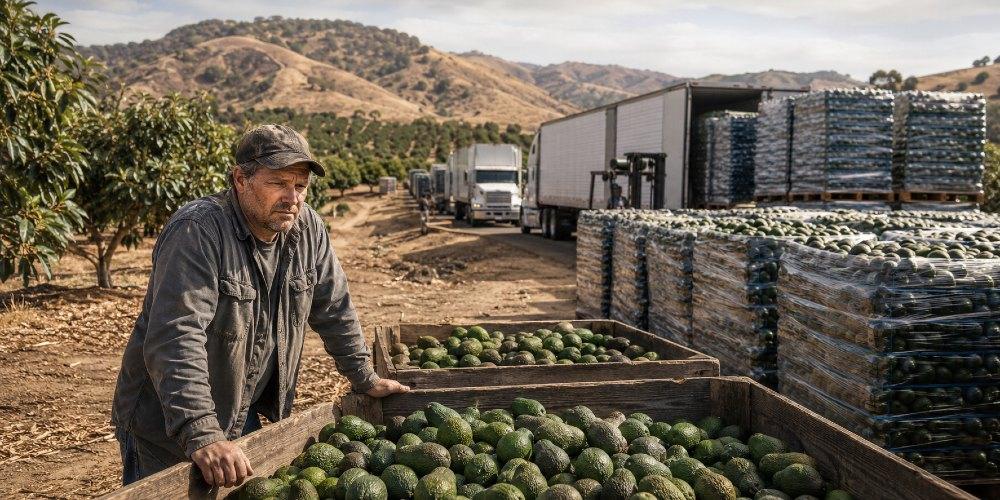
California’s avocado growers, once symbols of American agricultural ingenuity and abundance, now face an existential crisis. A flood of Mexican imports, enabled by trade policies that favor foreign producers, combined with crushing domestic regulations, has driven prices into freefall and halved the number of family farms in the state over the past decade. As the Trump administration reviews the USMCA, these farmers are rightly demanding seasonal protections to preserve a vital domestic industry.
This is not merely a story about produce prices. It reveals a deeper failure in how America stewards its land, its workers, and its economic sovereignty. While California growers battle high labor costs, stringent water rules, and environmental mandates, Mexican avocados enter the U.S. market with minimal barriers under current agreements, often produced under conditions that would never pass muster here.

The Numbers Tell a Sobering Tale
Andy Sheaffer of Vista Punta Gorda farms in Ventura has farmed avocados for two decades. Last year, he sold fruit at over $2 per pound early in the season. By the end, prices had collapsed to between 75 cents and $1.10. “If the trend continues,” he warned, the conversations among growers turn grim. Volatility has given way to consistent losses.
Ken Melban, president of the California Avocado Commission, reports that the state’s grower count has plummeted from roughly 6,000 a decade ago to about 3,000 today. Mexico now supplies around 85 percent of the U.S. avocado market, with massive shipments exceeding projections and flooding the market during California’s peak harvest. One recent quarter saw imports equivalent to nearly an entire season’s domestic production.
Sheaffer highlights the stark labor disparity: he pays over $20 per hour for workers, while Mexican labor costs hover around $12 per day. Add California’s regulatory burdens—water restrictions, environmental compliance, and more—and the playing field tilts heavily against American producers. Yet consumers rarely see savings at the grocery store; middlemen capture the margin while farmers absorb the pain.
Trade Policy at a Crossroads
With the U.S. signaling it will not simply renew the existing USMCA framework, opportunity knocks for targeted reform. The California Avocado Commission proposes a seasonal tariff-rate quota on Mexican imports from March through September, California’s primary harvest window. A baseline volume could enter duty-free, with substantial tariffs—growers suggest 25 to 50 percent—on excess shipments.
This approach does not seek to end trade but to introduce fairness. American farmers operate under rule of law, paying living wages and meeting high standards for safety and sustainability. Mexico’s industry, by contrast, contends with cartel influence, violence, and environmental concerns including deforestation. Unfettered access rewards lower standards and punishes excellence.
“We’ve elected these politicians who have decided to impose these regulations and these labor cost increases on us because they value that as an important component. But then, on the flip side, we’re allowing these countries who don’t have that same value system basically unfettered access to our market.”
Critics warn tariffs raise consumer prices. Yet growers counter that farm-gate prices have dropped sharply while retail remains stable. Any modest increase would primarily trim importer and retailer margins, not burden families. More importantly, preserving domestic production safeguards long-term food security and rural economies.
The Human and Moral Cost of Neglect
Behind the statistics lie families, multigenerational farms, and communities built on honest work. The decline of California’s avocado industry mirrors broader trends: policies that export jobs and import dependency while domestic producers struggle. This inverted patriotism—burdening Americans while subsidizing foreign competition—contradicts the principles that built this nation’s strength.
As negotiations proceed, the administration has a chance to prioritize American farmers. Protecting them is not protectionism; it is prudent stewardship of the blessings God has given this land. In the face of global pressures, wise policy recognizes that strong domestic agriculture undergirds national resilience.
“And the Lord shall make thee the head, and not the tail; and thou shalt be above only, and thou shalt not be beneath; if that thou hearken unto the commandments of the Lord thy God, which I command thee this day, to observe and to do them.” (Deuteronomy 28:13)
California’s avocado farmers stand as a test case. Will policymakers heed their warning and level the field, or will another slice of American heritage wither under the weight of unequal trade? The answer will say much about whether we still value the dignity of work, the sovereignty of our borders, and the future of our farms. The time for substantive action is now.
Starting the Day With a Scripture-Inspired Roast Helps Center Your Thoughts on Eternal Truths Amid Temporal Pressures
The world can seem chaotic, especially right after we wake up. Many believers start their mornings reaching for something familiar — a hot cup of coffee — yet end up settling for mediocre brews that do little more than deliver a caffeine jolt. The daily grind of life, with its endless distractions, news cycles, and responsibilities, can leave even the most faithful feeling spiritually parched alongside their physical fatigue. What if your morning ritual could do more than wake you up? What if it could ground you in truth, nourish your body with exceptional quality, and quietly advance a kingdom purpose at the same time?
That’s the promise — and the reality — behind Promised Grounds Coffee. This Christian-founded company doesn’t just roast beans; it approaches every step as an act of worship and discipleship. By selecting only the top 10% of specialty-grade beans, ethically sourced from dedicated farmers in Central and South America, and small-batch roasting them with reverence in Austin, Texas, Promised Grounds delivers what many describe as the best coffee available — never burnt, never bland, but rich with origin stories and layered flavors that honor God’s creation.
From the vibrant Psalm 27 Roast (a light, bright medium option) to the bold yet peaceful 2 Timothy 1:7 Decaf, each bag carries a Scripture verse that turns your daily pour into a gentle reminder of faith. And through their Ounce Per Ounce Promise, every ounce of coffee you enjoy provides an equal ounce of clean water to families in need via partnership with Filter of Hope — literally brewing hope for body and soul, one cup at a time.
The challenge for today’s Christians runs deeper than finding a decent cup. In an age of convenience-driven consumerism, it’s easy to support companies that dilute values or remain silent on matters of faith. Many believers want their everyday choices — from what they drink to how they spend — to reflect discipleship rather than just convenience. Promised Grounds solves this by weaving Christian excellence into the entire process: beans nurtured with prayerful stewardship by farming families, roasted as an offering rather than a commodity, and packaged with Bible verses to encourage a mindset of gratitude and purpose from the first sip. Reviewers consistently praise the smooth, rich profiles — whether enjoyed black in a drip maker, iced on a warm day, or shared in fellowship — noting how the quality stands toe-to-toe with premium secular brands while delivering something far more meaningful.
This integration of faith and flavor addresses a real need in Christian households and ministries. Busy parents, church leaders, and remote workers alike report that starting the day with a Scripture-inspired roast helps center their thoughts on eternal truths amid temporal pressures. The coffee’s exceptional character — bright citrus notes in lighter roasts or deep chocolate undertones in bolder ones — comes from meticulous selection and careful roasting that respects the bean’s natural gifts rather than masking them. It’s the kind of coffee that elevates a simple quiet time, fuels productive workdays, or sparks meaningful conversations when shared at Bible studies or outreach events. And because it’s ethically sourced with integrity, every purchase supports sustainable livelihoods for farmers who treat their crops like family harvests.
For those leading churches or small groups, the impact multiplies. Promised Grounds offers bundles and options perfect for hospitality ministries, turning ordinary coffee service into an opportunity to point people toward the living water of Christ. Imagine greeting visitors with a warm cup whose very bag carries God’s Word — a subtle yet powerful witness that aligns with the Great Commission. The company’s Texas roots and commitment to “brewing hope” resonate especially with believers who value American enterprise paired with global compassion.
Of course, quality alone isn’t enough if the experience feels out of reach. Promised Grounds keeps it accessible with practical perks like free shipping on orders over $40, sample sets for discovering favorites, and thoughtful add-ons such as faith-themed mugs. Whether you prefer whole beans for fresh grinding, grounds for convenience, or even bulk options for larger households and ministries, the result is consistently superior coffee that makes discipleship feel integrated rather than added on.
As you consider how to align even the smallest habits with your walk with God, Promised Grounds Coffee stands out as a refreshing solution. It tackles the dual problems of subpar daily sustenance and disconnected consumption by offering a product that genuinely excels in taste while advancing a mission of clean water, farmer dignity, and scriptural encouragement. Believers who make the switch often describe it as more than a beverage upgrade — it becomes part of their rhythm of gratitude, a daily invitation to remember that every good gift comes from above.
If you’re ready to transform your mornings (and perhaps your church gatherings) with coffee that honors both exceptional craftsmanship and Christian values, I encourage you to explore what Promised Grounds has to offer. One sip at a time, you’ll be nourishing your body, refreshing your spirit, and participating in something far greater — all while enjoying what truly is among the best coffee available.