
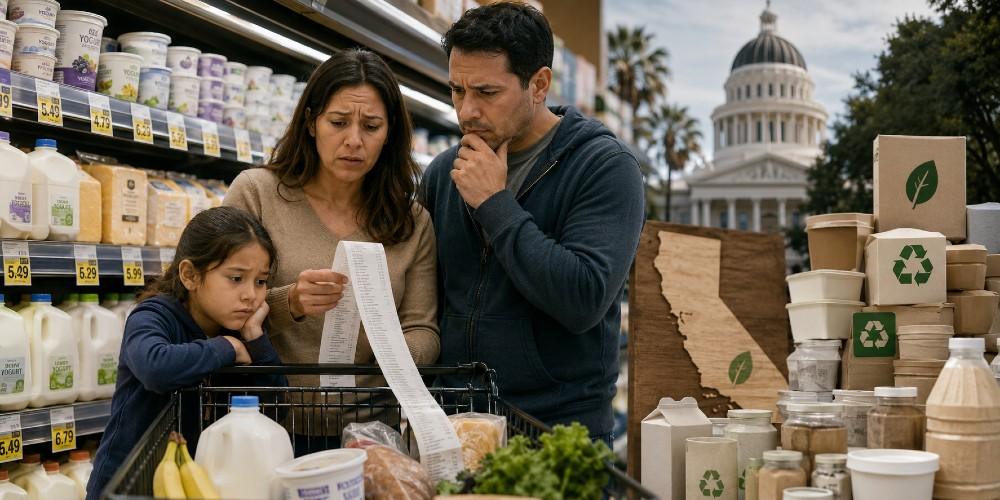
California families already grappling with some of the nation’s highest costs of living are about to face another hit at the grocery store. Senate Bill 54, the Plastic Pollution Prevention and Packaging Producer Responsibility Act, is now rolling out its first phase of implementation, forcing manufacturers to shoulder the costs of packaging waste and comply with stringent recyclability standards. The result? Higher prices on everyday staples, with dairy products among the hardest hit.
This law exemplifies the progressive tendency to impose top-down environmental solutions without fully accounting for real-world consequences on working families. Rather than letting market forces and innovation drive sustainable practices, Sacramento has chosen to make producers financially responsible for the end-of-life of packaging.

Companies must now pay impact fees, redesign packaging, and meet aggressive targets: 25 percent reduction in single-use plastic by 2032, 65 percent recycling rates for plastic packaging, and 100 percent recyclability or compostability for all single-use packaging.
While framed as a victory for the environment, the policy shifts costs directly to consumers. Dairy manufacturers warn of significant disruptions due to unique food safety requirements that current recyclable alternatives struggle to meet. The transition could force some businesses to shut down or leave the state altogether, further constraining supply and driving up prices.
CalRecycle estimates an annual household increase of $57 to $190, but industry voices suggest the pain will be sharper, especially for milk, cheese, and other perishables reliant on specialized packaging.
State Sen. Ben Allen, the bill’s author, celebrated the measure for ensuring “companies that profit from this mass pollution help pay for its cleanup.” Yet this rhetoric ignores how such mandates inevitably pass through to the very taxpayers and ratepayers the law claims to protect. Local governments may see some relief in waste management costs, but families stretching paychecks will bear the immediate brunt at checkout lines.
The Broader Pattern of Costly Virtue Signaling
California’s experiment with extended producer responsibility joins a litany of regulations that prioritize ideological goals over economic reality. From the $20 fast-food minimum wage that jacked up menu prices to plastic bag bans and date-label changes, the state’s approach consistently burdens consumers and small businesses while delivering questionable environmental gains. Grocery bills were already climbing due to inflation, supply chain issues, and prior policies; SB 54 adds another layer of misery.
Critics rightly point out that the law faces legal challenges from multiple fronts, including a coalition of Republican-led states arguing the requirements are overly burdensome. Environmental groups have also sued, claiming the regulations were weakened. Such discord underscores the flawed execution of what was sold as a comprehensive solution.
Dairy industry representatives highlight practical barriers: alternatives to traditional packaging often fail food safety standards or require massive capital investments in production lines—costs that will ultimately reach consumers. One estimate for switching a single mid-size line runs into tens of millions. This is not abstract environmentalism; it is policy that raises the price of nourishing families.
Supporters tout projected benefits like reduced landfill waste and improved recycling infrastructure, claiming returns of 2.5 times the costs. But history shows California’s grand environmental schemes often underdeliver while overtaxing residents. The state already leads in poverty when adjusted for cost of living, with families forgoing basics amid relentless price hikes.
“Rather than forcing taxpayers and ratepayers to shoulder these costs, we are ensuring companies that profit from this mass pollution help pay for its cleanup.”
This statement from Sen. Allen reveals the core misunderstanding. Companies do not absorb costs in a vacuum; they operate in competitive markets and pass expenses along. The true burden falls on California shoppers, many of whom are already voting with their feet by leaving the state.
Faith, Stewardship, and Prudence
In the biblical worldview, humans are called to stewardship of creation, but never at the expense of wisdom or the welfare of the vulnerable. As Genesis reminds us of humanity’s dominion with responsibility, hasty mandates that harm the least among us demand scrutiny. California policymakers would do well to consider whether their approach truly reflects careful dominion or merely performative environmentalism that squeezes families already under pressure.
The deeper issue extends beyond one bill. Progressive governance in California has transformed the Golden State into a cautionary tale of how good intentions, untethered from economic and practical realities, produce widespread hardship. As grocery bills spike once more, residents face the predictable outcome of layering regulation upon regulation without regard for cumulative effects.
Other states should watch closely. True environmental progress comes through innovation, not mandates that punish producers and consumers alike. California’s path risks accelerating out-migration and entrenching poverty under the guise of planetary salvation. Families deserve policies that strengthen rather than strain their ability to provide. Until Sacramento learns this lesson, expect more misery on the menu.

Starting the Day With a Scripture-Inspired Roast Helps Center Your Thoughts on Eternal Truths Amid Temporal Pressures
The world can seem chaotic, especially right after we wake up. Many believers start their mornings reaching for something familiar — a hot cup of coffee — yet end up settling for mediocre brews that do little more than deliver a caffeine jolt. The daily grind of life, with its endless distractions, news cycles, and responsibilities, can leave even the most faithful feeling spiritually parched alongside their physical fatigue. What if your morning ritual could do more than wake you up? What if it could ground you in truth, nourish your body with exceptional quality, and quietly advance a kingdom purpose at the same time?
That’s the promise — and the reality — behind Promised Grounds Coffee. This Christian-founded company doesn’t just roast beans; it approaches every step as an act of worship and discipleship. By selecting only the top 10% of specialty-grade beans, ethically sourced from dedicated farmers in Central and South America, and small-batch roasting them with reverence in Austin, Texas, Promised Grounds delivers what many describe as the best coffee available — never burnt, never bland, but rich with origin stories and layered flavors that honor God’s creation.
From the vibrant Psalm 27 Roast (a light, bright medium option) to the bold yet peaceful 2 Timothy 1:7 Decaf, each bag carries a Scripture verse that turns your daily pour into a gentle reminder of faith. And through their Ounce Per Ounce Promise, every ounce of coffee you enjoy provides an equal ounce of clean water to families in need via partnership with Filter of Hope — literally brewing hope for body and soul, one cup at a time.
The challenge for today’s Christians runs deeper than finding a decent cup. In an age of convenience-driven consumerism, it’s easy to support companies that dilute values or remain silent on matters of faith. Many believers want their everyday choices — from what they drink to how they spend — to reflect discipleship rather than just convenience. Promised Grounds solves this by weaving Christian excellence into the entire process: beans nurtured with prayerful stewardship by farming families, roasted as an offering rather than a commodity, and packaged with Bible verses to encourage a mindset of gratitude and purpose from the first sip. Reviewers consistently praise the smooth, rich profiles — whether enjoyed black in a drip maker, iced on a warm day, or shared in fellowship — noting how the quality stands toe-to-toe with premium secular brands while delivering something far more meaningful.
This integration of faith and flavor addresses a real need in Christian households and ministries. Busy parents, church leaders, and remote workers alike report that starting the day with a Scripture-inspired roast helps center their thoughts on eternal truths amid temporal pressures. The coffee’s exceptional character — bright citrus notes in lighter roasts or deep chocolate undertones in bolder ones — comes from meticulous selection and careful roasting that respects the bean’s natural gifts rather than masking them. It’s the kind of coffee that elevates a simple quiet time, fuels productive workdays, or sparks meaningful conversations when shared at Bible studies or outreach events. And because it’s ethically sourced with integrity, every purchase supports sustainable livelihoods for farmers who treat their crops like family harvests.
For those leading churches or small groups, the impact multiplies. Promised Grounds offers bundles and options perfect for hospitality ministries, turning ordinary coffee service into an opportunity to point people toward the living water of Christ. Imagine greeting visitors with a warm cup whose very bag carries God’s Word — a subtle yet powerful witness that aligns with the Great Commission. The company’s Texas roots and commitment to “brewing hope” resonate especially with believers who value American enterprise paired with global compassion.
Of course, quality alone isn’t enough if the experience feels out of reach. Promised Grounds keeps it accessible with practical perks like free shipping on orders over $40, sample sets for discovering favorites, and thoughtful add-ons such as faith-themed mugs. Whether you prefer whole beans for fresh grinding, grounds for convenience, or even bulk options for larger households and ministries, the result is consistently superior coffee that makes discipleship feel integrated rather than added on.
As you consider how to align even the smallest habits with your walk with God, Promised Grounds Coffee stands out as a refreshing solution. It tackles the dual problems of subpar daily sustenance and disconnected consumption by offering a product that genuinely excels in taste while advancing a mission of clean water, farmer dignity, and scriptural encouragement. Believers who make the switch often describe it as more than a beverage upgrade — it becomes part of their rhythm of gratitude, a daily invitation to remember that every good gift comes from above.
If you’re ready to transform your mornings (and perhaps your church gatherings) with coffee that honors both exceptional craftsmanship and Christian values, I encourage you to explore what Promised Grounds has to offer. One sip at a time, you’ll be nourishing your body, refreshing your spirit, and participating in something far greater — all while enjoying what truly is among the best coffee available.