
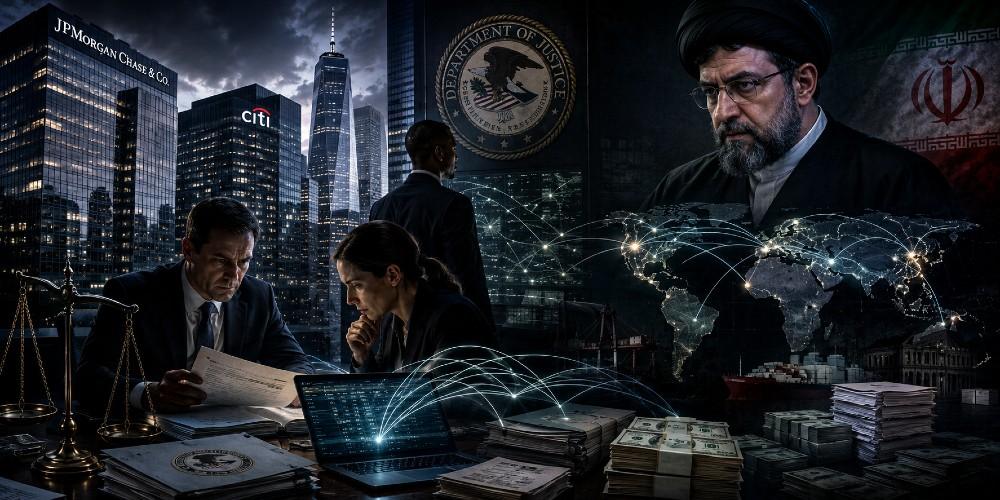
The Department of Justice has turned its attention to major Wall Street players JPMorgan Chase and Citigroup over their reported involvement in transactions linked to a sprawling business network controlled by Iran’s Supreme Leader Mojtaba Khamenei.
According to multiple reports, federal investigators are examining how entities tied to Iran’s leadership built a global investment portfolio that touched U.S. financial institutions, raising fresh questions about the effectiveness of sanctions designed to curb the regime’s malign activities.

This probe comes at a critical juncture. With the Trump administration applying maximum pressure on Tehran, the inquiry underscores a persistent vulnerability: even as America seeks to isolate a regime that sponsors terrorism and pursues nuclear ambitions, sophisticated financial networks appear to have facilitated the flow of funds.
The focus remains primarily on Khamenei’s network rather than the banks themselves, but the implications for due diligence across global finance could prove significant.
Bloomberg first detailed the investigation, citing officials familiar with the matter. The DOJ is looking into allegations of money laundering and corruption involving companies overseen by Khamenei, with transactions routed through or involving Wall Street giants.
JPMorgan and Citigroup have not commented publicly, and no charges have been announced. Yet the mere existence of such scrutiny highlights how Iran’s leadership has reportedly navigated complex international structures to amass and move wealth despite longstanding sanctions.
The Architecture of Evasion
Iran’s Supreme Leader holds ultimate authority over state decisions, including foreign policy and the nuclear program. Following the death of his father, Ayatollah Ali Khamenei, in a U.S.-Israeli strike, Mojtaba Khamenei inherited not only power but also an extensive web of business interests.
Investigators are now tracing how these entities built investment portfolios with exposure to American banks, including large money movements between affiliated firms.
This is not an isolated lapse. For years, Iran has perfected the art of sanctions evasion through front companies, third-party intermediaries, and opaque ownership structures. The involvement of major U.S. institutions, even if unwitting, points to gaps in compliance systems that regulators have long warned about.
Global banks process trillions in transactions daily, but when those flows benefit a regime that arms proxies like Hezbollah and Hamas, the stakes extend far beyond balance sheets.
Conservatives have long argued that weak enforcement and overreliance on international norms enable adversaries. The Biden years saw sanctions relief and diplomatic overtures that only emboldened Tehran. Now, under renewed pressure, the DOJ’s actions suggest a return to accountability. Scrutinizing these transactions is essential to mapping the full scope of Iran’s financial empire and plugging the holes that allow it to persist.
Broader Implications for National Security
The timing aligns with heightened tensions. The administration has intensified economic and diplomatic measures against Iran, seeking to disrupt funding for its nuclear program and regional terror networks. A probe into Wall Street’s role reinforces the message that no entity is above scrutiny when it comes to enabling sanctioned regimes.
Critics of lax financial oversight will see this as validation of their warnings. Major banks have faced billions in fines for past sanctions violations, yet the complexity of modern finance—layered through correspondent banking and investment vehicles—continues to create opportunities for evasion. The DOJ’s review of U.S. banks’ potential facilitation of these flows could lead to stronger compliance standards and more aggressive enforcement.
As details emerge, the case exposes the uncomfortable reality that American financial power, while a tool for good, can inadvertently serve evil when vigilance falters. Iran’s leadership has used its position to build personal and regime wealth, funding activities that threaten U.S. allies and interests worldwide. Holding institutions accountable is not about punishment for its own sake but about restoring the integrity of systems meant to serve the American people and counter adversaries.

In the midst of these revelations, Scripture reminds us of the enduring battle between light and darkness. As Ephesians 5:11 instructs, “And have no fellowship with the unfruitful works of darkness, but rather reprove them.”
This call to discernment and moral clarity applies as much to financial dealings as to personal conduct, urging a rejection of any complicity in regimes that defy justice and oppress their own people.
The DOJ probe into JPMorgan, Citigroup, and the Iranian network should serve as a wake-up call. True security demands not only military strength but rigorous financial warfare against those who threaten freedom.
As the investigation proceeds, Americans deserve transparency and decisive action to ensure Wall Street serves national interests rather than undermining them through back channels to Tehran.
Starting the Day With a Scripture-Inspired Roast Helps Center Your Thoughts on Eternal Truths Amid Temporal Pressures
The world can seem chaotic, especially right after we wake up. Many believers start their mornings reaching for something familiar — a hot cup of coffee — yet end up settling for mediocre brews that do little more than deliver a caffeine jolt. The daily grind of life, with its endless distractions, news cycles, and responsibilities, can leave even the most faithful feeling spiritually parched alongside their physical fatigue. What if your morning ritual could do more than wake you up? What if it could ground you in truth, nourish your body with exceptional quality, and quietly advance a kingdom purpose at the same time?
That’s the promise — and the reality — behind Promised Grounds Coffee. This Christian-founded company doesn’t just roast beans; it approaches every step as an act of worship and discipleship. By selecting only the top 10% of specialty-grade beans, ethically sourced from dedicated farmers in Central and South America, and small-batch roasting them with reverence in Austin, Texas, Promised Grounds delivers what many describe as the best coffee available — never burnt, never bland, but rich with origin stories and layered flavors that honor God’s creation.
From the vibrant Psalm 27 Roast (a light, bright medium option) to the bold yet peaceful 2 Timothy 1:7 Decaf, each bag carries a Scripture verse that turns your daily pour into a gentle reminder of faith. And through their Ounce Per Ounce Promise, every ounce of coffee you enjoy provides an equal ounce of clean water to families in need via partnership with Filter of Hope — literally brewing hope for body and soul, one cup at a time.
The challenge for today’s Christians runs deeper than finding a decent cup. In an age of convenience-driven consumerism, it’s easy to support companies that dilute values or remain silent on matters of faith. Many believers want their everyday choices — from what they drink to how they spend — to reflect discipleship rather than just convenience. Promised Grounds solves this by weaving Christian excellence into the entire process: beans nurtured with prayerful stewardship by farming families, roasted as an offering rather than a commodity, and packaged with Bible verses to encourage a mindset of gratitude and purpose from the first sip. Reviewers consistently praise the smooth, rich profiles — whether enjoyed black in a drip maker, iced on a warm day, or shared in fellowship — noting how the quality stands toe-to-toe with premium secular brands while delivering something far more meaningful.
This integration of faith and flavor addresses a real need in Christian households and ministries. Busy parents, church leaders, and remote workers alike report that starting the day with a Scripture-inspired roast helps center their thoughts on eternal truths amid temporal pressures. The coffee’s exceptional character — bright citrus notes in lighter roasts or deep chocolate undertones in bolder ones — comes from meticulous selection and careful roasting that respects the bean’s natural gifts rather than masking them. It’s the kind of coffee that elevates a simple quiet time, fuels productive workdays, or sparks meaningful conversations when shared at Bible studies or outreach events. And because it’s ethically sourced with integrity, every purchase supports sustainable livelihoods for farmers who treat their crops like family harvests.
For those leading churches or small groups, the impact multiplies. Promised Grounds offers bundles and options perfect for hospitality ministries, turning ordinary coffee service into an opportunity to point people toward the living water of Christ. Imagine greeting visitors with a warm cup whose very bag carries God’s Word — a subtle yet powerful witness that aligns with the Great Commission. The company’s Texas roots and commitment to “brewing hope” resonate especially with believers who value American enterprise paired with global compassion.
Of course, quality alone isn’t enough if the experience feels out of reach. Promised Grounds keeps it accessible with practical perks like free shipping on orders over $40, sample sets for discovering favorites, and thoughtful add-ons such as faith-themed mugs. Whether you prefer whole beans for fresh grinding, grounds for convenience, or even bulk options for larger households and ministries, the result is consistently superior coffee that makes discipleship feel integrated rather than added on.
As you consider how to align even the smallest habits with your walk with God, Promised Grounds Coffee stands out as a refreshing solution. It tackles the dual problems of subpar daily sustenance and disconnected consumption by offering a product that genuinely excels in taste while advancing a mission of clean water, farmer dignity, and scriptural encouragement. Believers who make the switch often describe it as more than a beverage upgrade — it becomes part of their rhythm of gratitude, a daily invitation to remember that every good gift comes from above.
If you’re ready to transform your mornings (and perhaps your church gatherings) with coffee that honors both exceptional craftsmanship and Christian values, I encourage you to explore what Promised Grounds has to offer. One sip at a time, you’ll be nourishing your body, refreshing your spirit, and participating in something far greater — all while enjoying what truly is among the best coffee available.