
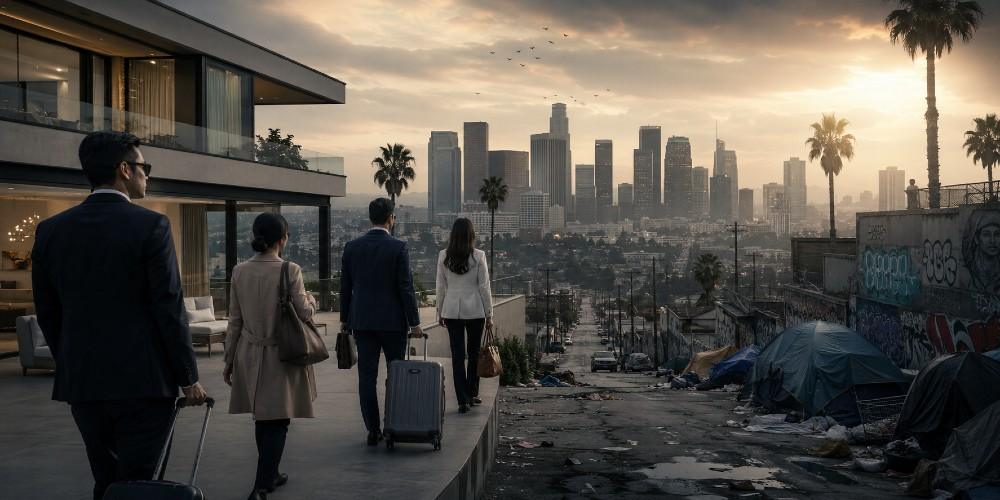
A stark new report from Realtor.com lays bare the unraveling appeal of Los Angeles on the global stage. Once a magnet for wealthy international homebuyers seeking sun, status, and opportunity, the City of Angels has seen its share of global real estate interest plummet from 7.9 percent in early 2020 to just 4.6 percent in the first quarter of 2026.
This is no mere market fluctuation. It signals a deeper reckoning with the consequences of decades of left-wing governance that have transformed one of America’s iconic cities into a cautionary tale of urban decay.

The data reveals a consistent slide across regions. Interest from North American buyers dropped from 5.8 percent in 2025 to 3.3 percent. European shoppers cooled from 8.9 percent to 5.7 percent, while Asian demand slipped from 8.9 percent to 6.1 percent.
The sharpest fall came from Oceania, nearly halved from 18.2 percent to 9.3 percent. Foreign investors are voting with their capital, turning instead toward Miami, New York, and even rising stars like Dallas.
This exodus of confidence mirrors the domestic flight from California that has accelerated in recent years. High taxes, burdensome regulations, and a cost of living that punishes success have driven both residents and businesses toward freer states.
Miami now commands over 10 percent of international demand, capitalizing on Florida’s no-income-tax environment and business-friendly policies. Los Angeles, by contrast, struggles under the weight of its own making.
Mayor Karen Bass’s administration has promised housing reforms and streamlining efforts, yet the results speak louder than press releases. Tent cities persist, crime statistics paint a troubling picture, and the regulatory thicket that once made development a nightmare remains largely intact despite incremental tweaks. Rival cities race ahead, courting investment with lower costs and fewer ideological experiments, while Los Angeles clings to policies that deter the very capital it desperately needs.
The irony abounds. Progressive leaders decry inequality while enacting measures that hollow out the middle class and repel high-net-worth individuals who could revitalize neighborhoods. They champion “equity” yet watch as foreign buyers—once eager to invest in Southern California’s dream—opt for markets where rule of law, public safety, and fiscal sanity prevail.
What was sold as compassionate governance has become economic self-sabotage.
Affordability gaps widen as competing cities offer better value. International shoppers notice what locals have endured for years: streets plagued by disorder, schools failing generations, and a business climate hostile to growth. The Realtor.com findings confirm a six-year trend that no amount of spin can conceal. Los Angeles is becoming a tougher sell precisely because its leaders prioritized ideology over results.
Even as some tout rezoning initiatives and adaptive reuse projects, the fundamental drivers of decline—skyrocketing taxes, energy costs, and unchecked social disorder—remain unaddressed. Domestic migration patterns tell the same story, with Californians seeking refuge in Texas, Florida, and Arizona where opportunity still thrives.
In the Book of Jeremiah, the prophet warns, “Thus saith the Lord; Cursed be the man that trusteth in man, and maketh flesh his arm, and whose heart departeth from the Lord.” Modern Los Angeles offers a living illustration of misplaced trust in human schemes and bureaucratic salvation. When cities abandon timeless principles of ordered liberty, stewardship, and moral clarity for utopian experiments, decline follows as surely as night follows day.
The doomsday report is not hyperbole but a mirror held up to failed leadership. Los Angeles retains immense natural advantages—its climate, ports, and cultural cachet. Yet without a decisive pivot toward sanity, these assets will continue to erode. International capital flows where it is welcomed, protected, and rewarded.
The City of Angels must choose: reclaim its promise through proven conservative fundamentals, or watch its global luster fade into irrelevance.

The world is watching. And increasingly, it is looking elsewhere.
Starting the Day With a Scripture-Inspired Roast Helps Center Your Thoughts on Eternal Truths Amid Temporal Pressures
The world can seem chaotic, especially right after we wake up. Many believers start their mornings reaching for something familiar — a hot cup of coffee — yet end up settling for mediocre brews that do little more than deliver a caffeine jolt. The daily grind of life, with its endless distractions, news cycles, and responsibilities, can leave even the most faithful feeling spiritually parched alongside their physical fatigue. What if your morning ritual could do more than wake you up? What if it could ground you in truth, nourish your body with exceptional quality, and quietly advance a kingdom purpose at the same time?
That’s the promise — and the reality — behind Promised Grounds Coffee. This Christian-founded company doesn’t just roast beans; it approaches every step as an act of worship and discipleship. By selecting only the top 10% of specialty-grade beans, ethically sourced from dedicated farmers in Central and South America, and small-batch roasting them with reverence in Austin, Texas, Promised Grounds delivers what many describe as the best coffee available — never burnt, never bland, but rich with origin stories and layered flavors that honor God’s creation.
From the vibrant Psalm 27 Roast (a light, bright medium option) to the bold yet peaceful 2 Timothy 1:7 Decaf, each bag carries a Scripture verse that turns your daily pour into a gentle reminder of faith. And through their Ounce Per Ounce Promise, every ounce of coffee you enjoy provides an equal ounce of clean water to families in need via partnership with Filter of Hope — literally brewing hope for body and soul, one cup at a time.
The challenge for today’s Christians runs deeper than finding a decent cup. In an age of convenience-driven consumerism, it’s easy to support companies that dilute values or remain silent on matters of faith. Many believers want their everyday choices — from what they drink to how they spend — to reflect discipleship rather than just convenience. Promised Grounds solves this by weaving Christian excellence into the entire process: beans nurtured with prayerful stewardship by farming families, roasted as an offering rather than a commodity, and packaged with Bible verses to encourage a mindset of gratitude and purpose from the first sip. Reviewers consistently praise the smooth, rich profiles — whether enjoyed black in a drip maker, iced on a warm day, or shared in fellowship — noting how the quality stands toe-to-toe with premium secular brands while delivering something far more meaningful.
This integration of faith and flavor addresses a real need in Christian households and ministries. Busy parents, church leaders, and remote workers alike report that starting the day with a Scripture-inspired roast helps center their thoughts on eternal truths amid temporal pressures. The coffee’s exceptional character — bright citrus notes in lighter roasts or deep chocolate undertones in bolder ones — comes from meticulous selection and careful roasting that respects the bean’s natural gifts rather than masking them. It’s the kind of coffee that elevates a simple quiet time, fuels productive workdays, or sparks meaningful conversations when shared at Bible studies or outreach events. And because it’s ethically sourced with integrity, every purchase supports sustainable livelihoods for farmers who treat their crops like family harvests.
For those leading churches or small groups, the impact multiplies. Promised Grounds offers bundles and options perfect for hospitality ministries, turning ordinary coffee service into an opportunity to point people toward the living water of Christ. Imagine greeting visitors with a warm cup whose very bag carries God’s Word — a subtle yet powerful witness that aligns with the Great Commission. The company’s Texas roots and commitment to “brewing hope” resonate especially with believers who value American enterprise paired with global compassion.
Of course, quality alone isn’t enough if the experience feels out of reach. Promised Grounds keeps it accessible with practical perks like free shipping on orders over $40, sample sets for discovering favorites, and thoughtful add-ons such as faith-themed mugs. Whether you prefer whole beans for fresh grinding, grounds for convenience, or even bulk options for larger households and ministries, the result is consistently superior coffee that makes discipleship feel integrated rather than added on.
As you consider how to align even the smallest habits with your walk with God, Promised Grounds Coffee stands out as a refreshing solution. It tackles the dual problems of subpar daily sustenance and disconnected consumption by offering a product that genuinely excels in taste while advancing a mission of clean water, farmer dignity, and scriptural encouragement. Believers who make the switch often describe it as more than a beverage upgrade — it becomes part of their rhythm of gratitude, a daily invitation to remember that every good gift comes from above.
If you’re ready to transform your mornings (and perhaps your church gatherings) with coffee that honors both exceptional craftsmanship and Christian values, I encourage you to explore what Promised Grounds has to offer. One sip at a time, you’ll be nourishing your body, refreshing your spirit, and participating in something far greater — all while enjoying what truly is among the best coffee available.