
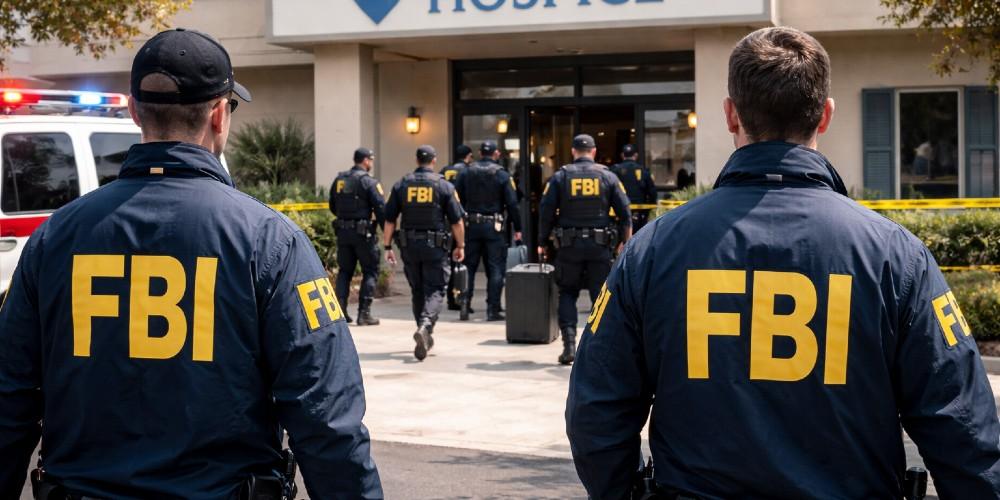
Before dawn on Thursday, FBI SWAT agents sawed through the metal front gate of a San Dimas, California, home and called out over loudspeakers for the occupants to surrender. Inside were Gladwin Gill, 66, a licensed psychologist, and his wife Amelou Gill, 70, a registered nurse — the couple behind St. Francis Palliative Care, a hospice in Glendale. What made the arrest especially striking was a single statistic buried in federal billing data: over a five-year period, their hospice reported a patient mortality rate of just 2.3%. In a facility built around caring for the dying, 97 out of every 100 patients were surviving. That number, federal prosecutors now allege, was not a medical miracle. It was evidence of fraud.
The early-morning raid was not an isolated enforcement action. It was the opening act of a sweeping federal crackdown on hospice fraud across Southern California — one that resulted in 15 defendants facing federal charges on Thursday alone, with more expected to follow. CMS Administrator Dr. Mehmet Oz, who was present at the scene, told reporters that federal regulators had suspended “hundreds” of hospice licenses in California by day’s end. The operation was conducted in coordination with Vice President JD Vance’s Fraud Taskforce, the FBI’s Los Angeles field office, the Department of Justice, and the Department of Health and Human Services.

The charges against the Gills are detailed and damning. Federal prosecutors allege the couple paid illegal kickbacks to recruiters who funneled patient referrals to their facility, then submitted more than $5.2 million in fraudulent Medicare claims for services that were either medically unnecessary or never provided at all. Medicare paid out more than $4 million on those claims — money that, according to the U.S. Attorney’s Office, the Gills funneled into mortgage payments, car payments, and air travel. The arrest warrant was signed by a federal judge, a fact U.S. Attorney Bill Essayli pointed out when asked about the political dimensions of the crackdown.
The Gills were not the only defendants arrested Thursday. Lolita Minerd, 65, of Anaheim — a licensed vocational nurse — was also taken into custody. She owned and operated a hospice in Artesia and, according to court documents, submitted more than $9.1 million in fraudulent Medicare claims over five years. Medicare paid her more than $8.5 million. Her hospice’s non-death discharge rate — meaning patients who left alive — stood at approximately 85 percent, nearly five times the national average of 17.2 percent. The scheme prosecutors describe is brazen: recruiters approached people at grocery markets and promised them free services and $300 per month in cash, delivered in envelopes, in exchange for enrolling in hospice care. Neither the patients nor their physicians identified any terminal illness. The patients received unneeded items — nutritional shakes, vitamins, wheelchairs — while Minerd allegedly collected Medicare reimbursements for end-of-life care that was never needed and never given.
In total, 15 defendants faced federal charges Thursday. Essayli noted that some of those defendants are currently incarcerated and had been running their fraud schemes from prison, working with co-conspirators on the outside. The depth of that detail — that people behind bars were still actively defrauding federal healthcare programs — speaks to how embedded and organized this fraud has become.
The scale of the problem in Los Angeles County borders on the surreal. According to CBS News, which spent months investigating hospice billing records across LA County, the typical hospice there billed Medicare roughly $29,000 per patient — more than double the national average of $13,200. Of the LA County hospices with available Medicare data, nearly all of them submitted bills above the national average. The county is home to nearly 2,000 licensed hospice providers. A 2022 state audit found that the number of hospice companies in LA County had grown by 1,500 percent since 2010, resulting in six times the national average of hospice providers per capita. State regulators visiting one office plaza in Van Nuys found 89 licensed hospice companies operating out of a single three-story glass building. Dr. Oz has been direct in his assessment: he believes roughly half of LA County’s hospices could be fraudulent.
How did it get this bad? The answer requires understanding what Medicare hospice billing actually looks like in practice. Hospice care is a federal benefit that covers end-of-life services for patients with a terminal diagnosis and a life expectancy of six months or less. Medicare reimburses hospice providers on a per-day basis, meaning operators are paid whether or not they deliver services — and whether or not the patient is actually dying. For a fraudulent operator, the playbook writes itself: recruit Medicare beneficiaries who are not terminally ill, enroll them in hospice, collect per-diem reimbursements, and provide little to nothing. The 2022 state audit identified the red flags: providers sharing the same address, patients with terminal diagnoses who were later discharged alive, excessive billing, and staff shared across multiple facilities. California’s government was aware of those red flags for at least four years before Thursday’s arrests.
That last point is central to the political dimension of this story. The House Oversight Committee, led by Chairman James Comer (R-KY), recently sent a letter to California Governor Gavin Newsom demanding documents related to the state’s oversight failures. The committee’s letter alleged that despite years of documented fraud indicators and a 2022 audit that detailed exactly what to look for, the Newsom administration failed to prevent or detect the schemes — and in doing so, enabled providers to defraud federal taxpayers and exploit some of the most vulnerable Americans in the healthcare system. Though Medicare is federally administered, the state of California licenses hospices to operate. A moratorium on issuing new hospice licenses was recently extended through January 2027 — because the state had missed its own deadline to enact new emergency regulations.
Dr. Oz has not been shy about naming the scope of the damage. He has stated that Los Angeles County alone accounts for approximately $3.5 billion in improper or fraudulent federal payments. He has also alleged that some of the fraudulent hospice networks are connected to foreign criminal organizations, including the Russian mafia. “When you try to bust these folks,” Oz said, “sometimes foreign nationals run back to their own country.” Whether or not every element of that allegation is ultimately proven in court, the pattern of abuse — foreign nationals establishing fraudulent healthcare businesses, billing federal programs, and absconding — has appeared in previous federal prosecutions and is not simply conjecture.
A previous California Post investigation, which appears to have directly contributed to Thursday’s enforcement actions, uncovered a network of suspicious physicians allegedly driving tens of millions of dollars in questionable hospice billing. One example cited was a registered dermatologist associated with 63 separate hospice facilities across California, either as a medical director or attending physician. That detail alone reflects what investigators call a core structural vulnerability in the hospice billing system: Medicare requires physician certification of terminal illness, but oversight of those certifications has been, at best, inadequate.
The federal government’s response under the current administration has been aggressive by any historical measure. Shortly after Vice President Vance’s anti-fraud task force stood up, federal funding was paused for 70 hospice and home health care providers in Los Angeles County. CMS has been using a Provisional Period of Enhanced Oversight — implemented in 2023 — to scrutinize newly enrolled hospices in California, Arizona, Nevada, and Texas. As of mid-2025, 668 hospices were subject to medical review under that program, with billing privileges revoked for 122 of them. The agency has since expanded prepayment review to existing licensed hospices in those states, and has added Georgia and Ohio to the enhanced oversight program as suspected hotspots emerge.
Dr. Oz has also indicated that the administration plans to use artificial intelligence to detect fraudulent Medicare and Medicaid claims nationwide — a development that, if implemented effectively, could dramatically accelerate the pace at which fraudulent billing patterns are identified. The hospice fraud problem is not unique to California, but California is, by virtually every metric, the most acute example in the country.
For the patients caught in these schemes, the harm is not merely financial. Many Medicare beneficiaries enrolled in fraudulent hospice programs did not know they had been signed up. Hospice enrollment typically means forgoing curative treatment — patients enrolled in hospice are expected to be pursuing comfort care rather than aggressive medical intervention. Enrolling a healthy person in hospice without their knowledge could, depending on how the enrollment is processed, affect their access to other medical treatment. Federal prosecutors and watchdogs have described this as exploitation of vulnerable people, and the language is accurate.
Thursday’s enforcement actions also carry a political undertone that is difficult to ignore, even if the legal merits stand entirely on their own. California under Governor Newsom has been the focal point of multiple federal investigations and oversight inquiries across a range of programs. The hospice fraud crackdown fits within a broader pattern of the Trump administration targeting what it describes as systemic failures in Democratic-led states — failures that result in federal taxpayer dollars flowing out of the system and into the pockets of criminal operators. Newsom and California officials have maintained that the state has been actively investigating and prosecuting hospice fraud for years, pointing to California Attorney General Rob Bonta’s cases, which have resulted in more than 100 criminal defendants. But critics note that with nearly 2,000 hospices in one county, 100 prosecutions over multiple years barely scratches the surface.

What Thursday’s operation demonstrated is that the federal government — at least under the current administration — is no longer willing to treat hospice fraud as a background enforcement priority. The choice to have Dr. Oz physically present at an early-morning FBI raid, with cameras rolling, signals something deliberate: this is meant to be visible. It is meant to send a message to fraudulent operators that the era of low-risk, high-reward Medicare theft in Southern California is ending. Whether the message is received will depend on how sustained and comprehensive the enforcement remains, and whether federal charges result in meaningful prison sentences that deter future actors.
The Gills and Lolita Minerd are presumed innocent until proven guilty in a court of law. The charges against them, however, are supported by federal billing data, patient records, and investigative work spanning years. If the government’s case holds, what the Gills operated was not a hospice. It was a business that collected federal money meant for the dying while serving people who had no terminal diagnosis — a fraud that mocked both the purpose of the Medicare program and the genuine suffering of patients who rely on legitimate end-of-life care. That is the moral core of this story, and it deserves to be stated plainly.
Fifteen defendants charged. Hundreds of licenses suspended. Billions of dollars in suspected fraud. And an FBI SWAT team at dawn, cutting through a gate to reach a couple who allegedly helped themselves to $4 million meant for the dying. Whatever else happens in the weeks ahead, Thursday was a significant day — not just for federal law enforcement, but for every American taxpayer who has watched Medicare’s hospice benefit get systematically looted while regulators looked the other way.
Two Storms, One Harvest

Every food crisis in living memory has been a one-shock event. The 2008 price spike was a commodity bubble. The 2020 shortages were a logistics failure. The 2022 grain scare was a war on one exporter’s ports. Each time, the system bent, adjusted, and recovered, and each time the experts assured us afterward that global markets are simply too big and too diversified to fail.
What nobody in Washington seems eager to discuss is that 2026 is shaping up to be something the modern food system has never actually faced. Two independent shocks, one climatic and one geopolitical, are converging on the same harvest cycle at the same time. Not sequentially. Simultaneously.
Start with the weather. The Pacific Ocean is currently building toward what forecasters now openly call a record event. NOAA’s Climate Prediction Center puts the odds of at least a strong El Niño near 88 percent, with roughly two in three odds it reaches “very strong” status, the tier reserved for perhaps three or four events in the entire satellite era. Every major global model now projects a median peak in Super El Niño territory, and most of them project it exceeding the 2015-16 event, which until now held the modern record. Sea surface anomalies were already brushing the super threshold in mid-July, months before these events normally peak. The atmosphere has already shifted into El Niño mode, and the event is forecast to crest in late fall and early winter.
This is not about “climate change.” It’s about the standard cycles of weather, and the cycle we’re currently in is one that has likely devastated societies in the past. We’re better prepared as a society today, but not all Americans are equally prepared.
Serious households have started doing the quiet math on their own. Grocery bills tell part of the story, and the forecast maps tell the rest, which is why long-term food storage has moved from fringe hobby to mainstream line item in the family budget, with established suppliers like Heaven’s Harvest seeing demand from people who five years ago would have rolled their eyes at the idea. That instinct is not paranoia. It is pattern recognition, and the pattern is worth walking through carefully.
Editor’s Note: Heaven’s Harvest IS a sponsor, but the warnings of this article are real and would be written even if we didn’t have a survival food sponsor. With that said, those who take advantage of what they offer can use promo code “Patriot” for 15% off.
The Fertilizer Clock Is Already Running
While the Pacific warms, the second shock has been unfolding in the Strait of Hormuz. The conflict with Iran turned the world’s most important energy chokepoint into a contested waterway, and the consequences reach far beyond the gas pump. Roughly a third of global fertilizer trade moves through Hormuz, and the disruption sent urea prices up 86 percent year over year by March, with a 53 percent jump in a single month.
The World Bank projects energy prices rising about 24 percent in 2026 and fertilizer about 31 percent. By its own accounting, fertilizer prices ran 35 percent higher in the first five months of this year than the same period last year.
Here is the mechanism the nightly news will not explain. Fertilizer is not a grocery item. It is a time-delayed input. The nitrogen a farmer in Iowa or Punjab could not afford to apply this spring does not show up as a problem this spring. It shows up as a thinner harvest six to twelve months later.
The World Bank’s own food security brief concedes that the effects of reduced applications earlier this season “are likely to become visible only later in harvest outcomes.” Translate that from institutional language into plain English and it means this. The damage is already done, it is already in the ground, and we are simply waiting for it to arrive on the shelf.
Now check the calendar. Six to twelve months from the spring planting season lands us squarely in late 2026 and early 2027. Which is precisely when the strongest El Niño in the instrumental record is forecast to peak, bringing its signature droughts to Southeast Asia, Australia, southern Africa, northern Brazil, and South Asia, the very regions that grow the world’s rice, sugar, and oilseeds.
The World Bank warns openly that a strong El Niño “could disrupt multiple crop belts simultaneously” on top of the conflict-driven input costs. Their baseline projection assumes the Middle East disruptions ease by autumn. What in the last two years of Middle East history suggests that assumption is safe?
The System Has No Slack Left
The comfortable answer is that global markets always adjust. But adjustment requires slack, and the slack is gone. Global cereal production is expected to decline from last year’s records even before El Niño does its work. The UN World Food Programme, hardly a den of right-wing preppers, is calling this the most significant disruption to its supply chains since Covid and the invasion of Ukraine, and its supply chain director put the stakes bluntly.
Today’s supply chain challenges are tomorrow’s hunger crisis.
There is also a political dimension that markets cannot price. When food gets scarce, governments do not behave like economists. They behave like politicians. Export bans, hoarding mandates, and panic buying at the national level turned the modest rice shortfall of 2008 into a global crisis, and analysts are already warning that import-dependent nations are the first dominoes.
The 2015-16 Super El Niño, a far weaker event than what is now forecast, threw tens of millions into food stress across Africa and Asia. This one is projected to be stronger, and it arrives with fertilizer already rationed by price and shipping lanes already contested by missiles.
What Joseph Knew
Scripture does not treat preparation for lean years as faithlessness. It treats it as wisdom delivered in advance to those willing to act on it.
Behold, there come seven years of great plenty throughout all the land of Egypt: And there shall arise after them seven years of famine; and all the plenty shall be forgotten in the land of Egypt.
Joseph did not respond to that warning with a hashtag or a committee. He stored grain during the years of abundance, and when the famine came, Egypt stood while its neighbors begged. The lesson is not that famine is certain. It is that the time to prepare is precisely when preparation still looks optional.
Nobody who filled a pantry in a year of plenty has ever regretted it, and nobody standing in an empty aisle has ever been glad he waited for certainty.
None of this calls for panic, and panic is the enemy of sound judgment anyway. It calls for the same unglamorous prudence our grandparents considered ordinary. Keep some cash margin, know your local growers, and put real food in deep storage while it is cheap and available, because the entire arc of this story is that cheap and available is a closing window.
Families looking for a straightforward place to start can visit Heaven’s Harvest and use promo code Patriot for 15 percent off long-term storable food. The forecasts may yet soften, the strait may yet reopen, and we should pray they do. But hope is a fine thing to hold and a foolish thing to eat.