
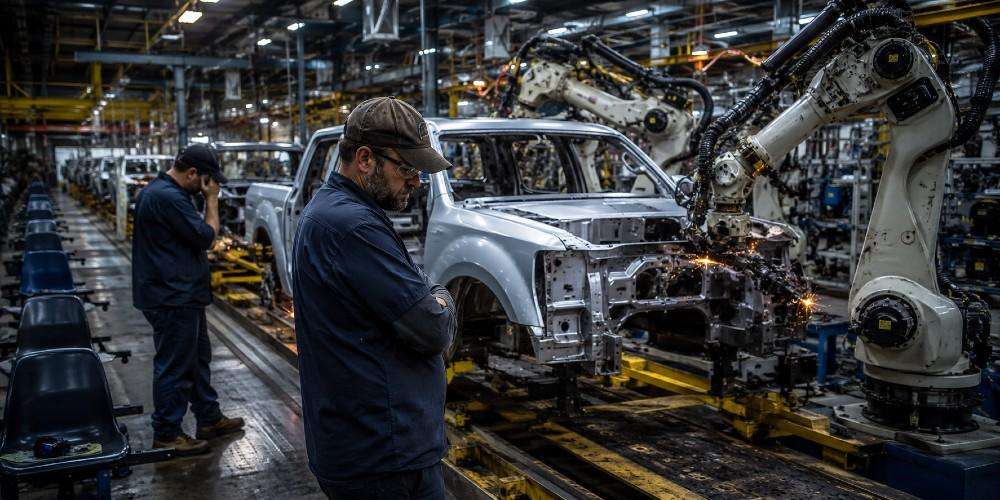

General Motors has delivered a stark lesson in modern American manufacturing: when government-pushed electric vehicle mandates meet market reality, it is the American worker who pays the price.
At the company’s flagship Factory Zero plant in Detroit-Hamtramck, more than 1,000 jobs have been eliminated, only to be partially filled by 50 collaborative robots, or “cobots,” now working alongside the remaining human employees attaching body panels on the assembly line.

This is not the story of innovation lifting all boats. It is the predictable outcome of an industry warped by political pressure to abandon proven internal combustion technology for expensive, low-demand EVs. GM softened its EV ambitions, paused production multiple times at the plant, and cut costs aggressively. The result? A workforce gutted while executives tout improved “safety and ergonomics.”
Union leaders are rightly furious. UAW Local 22 President James Cotton voiced the frustration of his members: “Our manpower is being taken away from us. From top to bottom, we’re disgusted that they have cobots in our plants.”
The union has filed grievances, highlighting legitimate concerns about job security and the risks of robots operating directly beside people. UAW President Shawn Fain framed it more broadly, arguing workers create unprecedented value yet fail to reap the harvest.
GM’s spokesman defended the move as essential for competitiveness, insisting the cobots enhance safety for remaining employees. Yet the timing could hardly be more tone-deaf. The company reported $4.25 billion in profits for the first quarter of 2026, a 22 percent increase year over year. Meanwhile, American autoworkers in the heart of Motor City face displacement.
The EV Mirage and Its Human Toll
The broader context reveals the folly of centralized industrial policy. Consumer demand for EVs has cooled significantly, driven by high costs, charging infrastructure gaps, and practical limitations that policymakers chose to ignore.
AAA surveys and repeated production pauses at Factory Zero underscore what many warned from the beginning: you cannot mandate a technology into viability when the market pushes back.
Automation in manufacturing is nothing new. Labor hours per vehicle have dropped dramatically since the 1980s. What stands out here is the acceleration amid policy-driven market distortion. Rising union wages secured in recent contracts clash with the economic pressures of unprofitable EV lines, leaving corporations with few options but to lean harder into robotics.
Critics on the left often decry corporate greed in such cases, yet remain strangely silent on the role of green mandates that forced automakers down this path. The same voices that celebrate “the future of work” rarely acknowledge the immediate pain inflicted on families who built this industry. Detroit’s proud legacy of American ingenuity is being hollowed out not solely by robots, but by decisions made far from the factory floor.
UAW grievances and worker outrage highlight a deeper tension: how do we ensure technological progress benefits the people who power our economy rather than rendering them obsolete? This is particularly acute in an America where manufacturing jobs have long anchored communities, provided dignity through honest labor, and supported multi-generational stability.
“The fruits of our labor have multiplied like never before, but workers aren’t reaping the harvest,”
said UAW President Shawn Fain. His words carry weight, even as solutions remain elusive in a contract negotiation cycle set for 2028.
Stewardship, Work, and the Human Element
These developments should prompt reflection beyond quarterly earnings reports. The Bible reminds us of the value of diligent hands and the importance of providing for one’s household. As 2 Thessalonians 3:10 declares, “For even when we were with you, this we commanded you, that if any would not work, neither should he eat.” Work is not merely economic; it carries moral and spiritual weight, forming character and sustaining families.
Corporate leaders and policymakers alike would do well to consider the long-term consequences of prioritizing efficiency over the people who execute it. True competitiveness comes not from discarding the workforce but from fostering environments where human ingenuity and technological tools complement one another.

America’s strength has always rested on opportunity for the working man, not on trading flesh-and-blood employees for machines in pursuit of fleeting political targets.
GM’s Detroit plant transformation serves as a cautionary tale. As automation spreads, our response must protect the dignity of labor while embracing genuine progress, unburdened by ideological fantasies that ignore human realities and market truths. The robots have arrived. The question remains whether our leaders will ensure American workers still have a place beside them.
Starting the Day With a Scripture-Inspired Roast Helps Center Your Thoughts on Eternal Truths Amid Temporal Pressures
The world can seem chaotic, especially right after we wake up. Many believers start their mornings reaching for something familiar — a hot cup of coffee — yet end up settling for mediocre brews that do little more than deliver a caffeine jolt. The daily grind of life, with its endless distractions, news cycles, and responsibilities, can leave even the most faithful feeling spiritually parched alongside their physical fatigue. What if your morning ritual could do more than wake you up? What if it could ground you in truth, nourish your body with exceptional quality, and quietly advance a kingdom purpose at the same time?
That’s the promise — and the reality — behind Promised Grounds Coffee. This Christian-founded company doesn’t just roast beans; it approaches every step as an act of worship and discipleship. By selecting only the top 10% of specialty-grade beans, ethically sourced from dedicated farmers in Central and South America, and small-batch roasting them with reverence in Austin, Texas, Promised Grounds delivers what many describe as the best coffee available — never burnt, never bland, but rich with origin stories and layered flavors that honor God’s creation.
From the vibrant Psalm 27 Roast (a light, bright medium option) to the bold yet peaceful 2 Timothy 1:7 Decaf, each bag carries a Scripture verse that turns your daily pour into a gentle reminder of faith. And through their Ounce Per Ounce Promise, every ounce of coffee you enjoy provides an equal ounce of clean water to families in need via partnership with Filter of Hope — literally brewing hope for body and soul, one cup at a time.
The challenge for today’s Christians runs deeper than finding a decent cup. In an age of convenience-driven consumerism, it’s easy to support companies that dilute values or remain silent on matters of faith. Many believers want their everyday choices — from what they drink to how they spend — to reflect discipleship rather than just convenience. Promised Grounds solves this by weaving Christian excellence into the entire process: beans nurtured with prayerful stewardship by farming families, roasted as an offering rather than a commodity, and packaged with Bible verses to encourage a mindset of gratitude and purpose from the first sip. Reviewers consistently praise the smooth, rich profiles — whether enjoyed black in a drip maker, iced on a warm day, or shared in fellowship — noting how the quality stands toe-to-toe with premium secular brands while delivering something far more meaningful.
This integration of faith and flavor addresses a real need in Christian households and ministries. Busy parents, church leaders, and remote workers alike report that starting the day with a Scripture-inspired roast helps center their thoughts on eternal truths amid temporal pressures. The coffee’s exceptional character — bright citrus notes in lighter roasts or deep chocolate undertones in bolder ones — comes from meticulous selection and careful roasting that respects the bean’s natural gifts rather than masking them. It’s the kind of coffee that elevates a simple quiet time, fuels productive workdays, or sparks meaningful conversations when shared at Bible studies or outreach events. And because it’s ethically sourced with integrity, every purchase supports sustainable livelihoods for farmers who treat their crops like family harvests.
For those leading churches or small groups, the impact multiplies. Promised Grounds offers bundles and options perfect for hospitality ministries, turning ordinary coffee service into an opportunity to point people toward the living water of Christ. Imagine greeting visitors with a warm cup whose very bag carries God’s Word — a subtle yet powerful witness that aligns with the Great Commission. The company’s Texas roots and commitment to “brewing hope” resonate especially with believers who value American enterprise paired with global compassion.
Of course, quality alone isn’t enough if the experience feels out of reach. Promised Grounds keeps it accessible with practical perks like free shipping on orders over $40, sample sets for discovering favorites, and thoughtful add-ons such as faith-themed mugs. Whether you prefer whole beans for fresh grinding, grounds for convenience, or even bulk options for larger households and ministries, the result is consistently superior coffee that makes discipleship feel integrated rather than added on.
As you consider how to align even the smallest habits with your walk with God, Promised Grounds Coffee stands out as a refreshing solution. It tackles the dual problems of subpar daily sustenance and disconnected consumption by offering a product that genuinely excels in taste while advancing a mission of clean water, farmer dignity, and scriptural encouragement. Believers who make the switch often describe it as more than a beverage upgrade — it becomes part of their rhythm of gratitude, a daily invitation to remember that every good gift comes from above.
If you’re ready to transform your mornings (and perhaps your church gatherings) with coffee that honors both exceptional craftsmanship and Christian values, I encourage you to explore what Promised Grounds has to offer. One sip at a time, you’ll be nourishing your body, refreshing your spirit, and participating in something far greater — all while enjoying what truly is among the best coffee available.