
(Zero Hedge)—Authored by Matthew Piepenburg via vongreyerz.gold. Is gold calling out a broken global financial system? One Big…Lie?
Earlier this year, I was asked to give my most “heretic” opinion about the global financial system. This was an unusual yet bold question, and after a brief pause, I answered that the entire system was…, well:

“A lie.”
This may seem like a sensational response in an industry sometimes prone to the sensational; however, if we look at stubborn facts, the answer is truer than it is extreme.
When it comes to a financial system rotting from within, the Botox-like beauty of our ballooning S&P and centralized credit market hides an aging and decrepit disease.
That is, policy lies, like Botox, can’t hide reality forever, and the evidence of a fatally debt-sick system hiding financial truths behind forked tongues and euphemistic lingo is literally all around us.
A Long List of Truth-Stretching…
From the very era of my birth, the list of lies is almost comical.
Nixon:
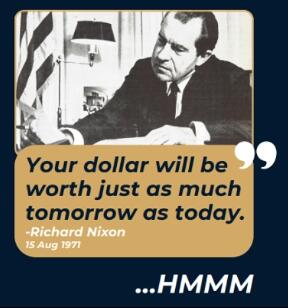
In 1971, for example, when Nixon decoupled the dollar from gold [thereby allowing his own and future administrations the unfettered luxury (and sickness) of expanding (debasing) the money supply], he promised the measure would be “temporary” and that “our dollar would be worth just as much tomorrow as it is today.”
Both statements, of course, were open lies.
54 years later, the dollar remains un-chaperoned to gold, and when measured against a milligram of that same precious metal, the USD (and other major Fiat currencies) has lost 99% of its purchasing power.
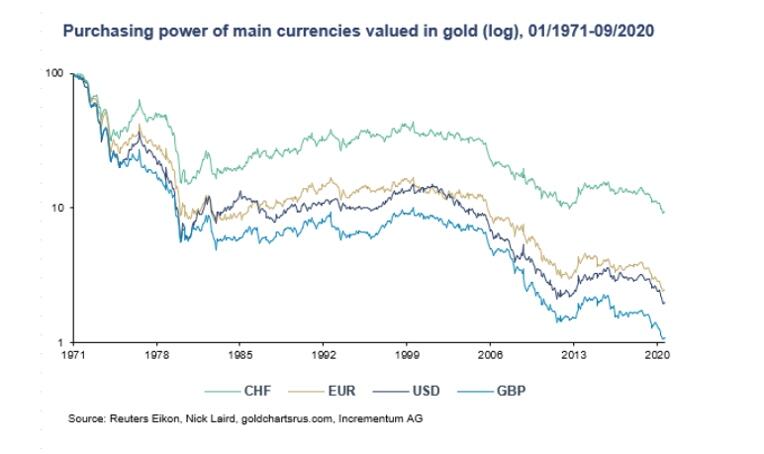
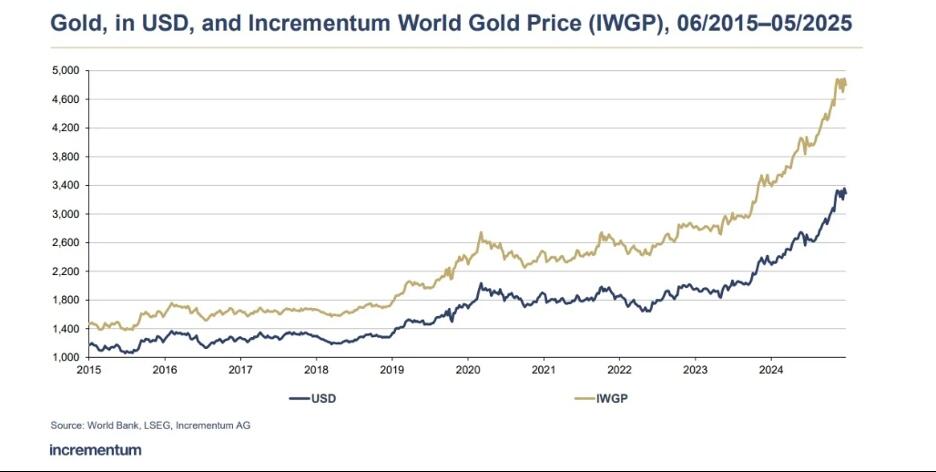
Meanwhile, gold is rising faster against the USD and other world currencies as their purchasing power is diluted by desperate policies to inflate away their debt with debased currencies.
Lying to Our Founding Fathers:
It’s also worth noting that our fiat paper Dollar, un-backed by gold, is a direct contradiction to our Constitution, and in my mind, is itself just another, well…Lie.
Wilson’s Fed:
But long before the lies of 1971, let us not forget the lie of 1913, when Wilson signed an equally unconstitutional Federal Reserve into law, a so-called “independent” bank which is anything but independent (it’s effectively a fourth branch of government) and is neither “Federal” nor a “Reserve.”
Larry Summers:
Fast forward to the great financial crisis of 2008, which was effectively a mortgage—backed-security credit implosion driven by an unregulated derivatives market, and we see even more staggering dishonesty.
A decade before this levered credit implosion, Assistant Treasury Secretary Larry Summers was called to Congress to answer Brooksley Born’s concerns (as head of the CFTC) that these derivative instruments, if left unregulated, would destabilize markets.

Summers publicly embarrassed Born and then told the world that the bankers in charge of these OTC instruments of levered destruction were more than sophisticated enough to manage the risks.
Of course, by the 2008 market implosion, we all knew that assertion was a lie.
Bernanke, Yellen & Powell:
We also know that when the markets tanked in 2008 (thanks largely to Mr. Summers’ deregulation fiasco), Bernanke’s subsequent promise that the money printing which followed (counterfeiting euphemistically called “Quantitative Easing”) would only be a “temporary” measure was just another lie.
QE1 was soon followed by QE 2,3,4 “Operation Twist” and then “Unlimited QE” by 2020.
But such lies are nothing new to central bankers. Remember Yellen?

And let us not forget Powell’s 2021 promise that the inflation (a direct result of the very money printing Bernanke promised would be “temporary” in 2010) facing the USA would only be “transitory.”
We knew then, as we still know today, that transitory inflation, like the very scale which measures CPI, were just more lies.
In fact, lies, like the euphemisms from on top, are almost standard policy from our so-called policy makers.
MMT:
“Modern Monetary Theory,” or “MMT,” for example, is neither modern, nor monetary, nor a theory.
The fantasy of believing a nation can solve a debt crisis via more debt, which is then monetized by creating fake money, has been tried from ancient Rome and 1789 France to 1990’s Yugoslavia.
But as history confirms, it has failed EVERY time.
Other Lies…
Other such lying euphemisms, from the “Patriot Act” and the “Department of Homeland Security” to the “safe and effective” of our now-pardoned “trust the science” leadership may be less economic, but they are no less dishonest—being far more about centralization than anything “patriotic” or “security” driven…
In sum, so many lies, so many examples.
And the fact that 99% of our nation’s now openly distrusted (by greater than 40% of the US population) media outlets are owned by just five mega-corporations, is it any wonder that such lies, as Mark Twain quipped, “can travel half way around the world while the truth is putting on its shoes”?
But as introduced above, eventually the lies can no longer hide what our eyes, intuition, and wallets can see, touch or feel.
Gold: The Ultimate Lie Detector
Toward this end, we clearly know we are reaching an inflection point in the global financial system when even the liars have started to confess the truth, and much of this truth is golden.
As I noted elsewhere, a group of European Central Bank economists have just said the quiet part out loud.
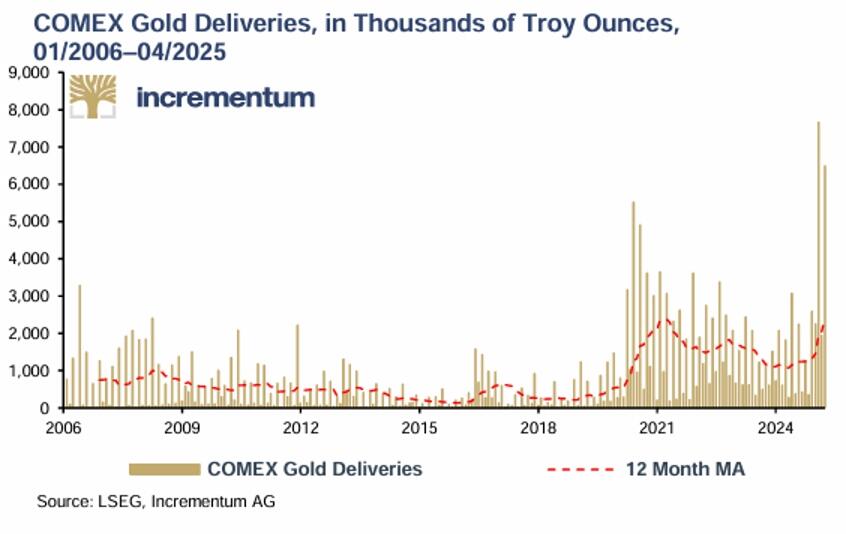
In a recent report, they warned that rising demand for physical gold (over 2000 tons from London to NYC in 2025) could send the European Union into collapse.
Why?
Because the Eurozone, already teetering on skyrocketing debts and rising bond yields (and hence interest rates), doesn’t have the money nor the gold to meet their 100:1 levered gold derivative contracts hitherto floating on the London and NY Gold Exchanges with a gross exposure of over $1T.
Yes, One TRILLION.
Sadly, we’ve been warning of this derivative time bomb and Comex insanity for years, yet only now the ECB is confessing its trillion-dollar problem out loud.
These metals exchanges, which rolled over and extended paper gold contracts since the 1970s to artificially short (i.e., price control) the gold price, were basically credit exchanges, not gold storage providers…
But now they are seeing counterparties wanting the physical gold itself rather than just their extended paper contracts.
Unfortunately, the Eurozone doesn’t have the gold their contracts promised.
In short, they are caught in a lie.
The other lie is trying to “blame” this leverage trap on gold while failing to confess that counterparties are seeking actual gold delivery to cover their own past sins.
That is, they need the gold because they trust this hitherto “pet rock” analog asset as a far, far superior store of value and reserve asset than the sovereign bonds and paper currencies they’ve been destroying for decades—something we have also been forewarning for years.
In other words, gold is no longer just a hedge or matter of speculation, it’s THE emerging global Tier-1 asset which even those folks at the BIS and IMF (notorious for “bending” truths) now openly recognize as THE reserve asset in a world openly losing confidence in the debased paper money and distrusted IOUs from a world falling off a $300T global debt cliff.
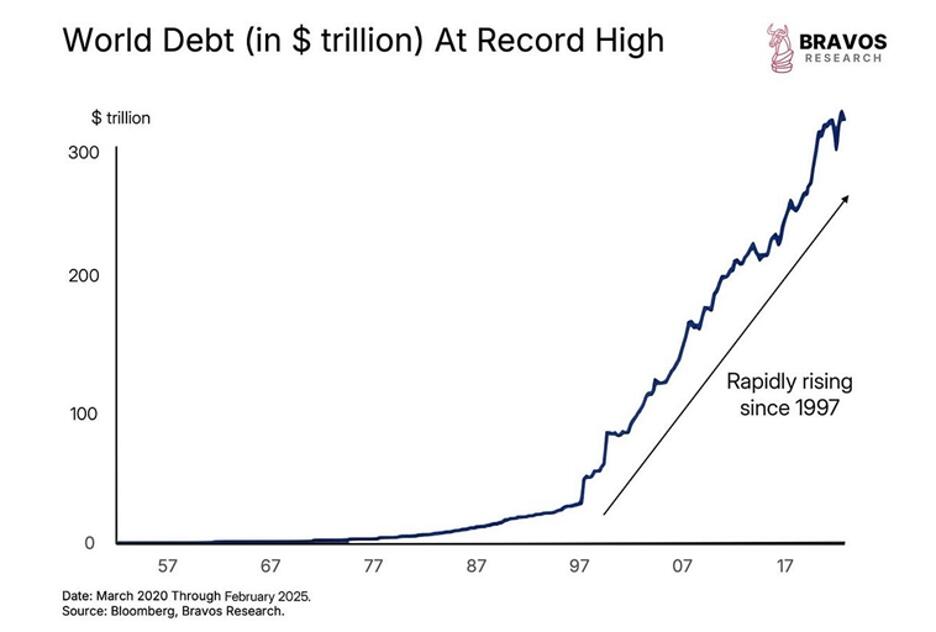
In short: Gold is calling BS on an entire global financial system whose dishonest fantasy policies of thinking they could take sovereign debt levels to unprecedented/historical and drunken levels to buy time, votes and wealth inequality without a hangover.
Or stated more simply, gold is unmasking the lie of deficits without tears, money printing without currency debasement and debt without destruction.
When I think of such “leaders” and financial policies, I am again reminded of Mark Twain, who observed: “I sometimes wonder if the world is being run by smart people who are putting us on, or by imbeciles who really mean it.”
No Surprise at All
But such imbecility (or dishonesty) is no surprise to those who understand math, history and sound money—i.e. those who understand gold.
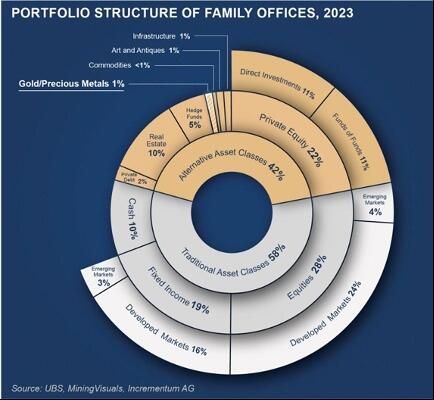
For years, family offices, private wealth advisors at lofty bank X, Y&Z and even RIA A, B&C have been telling themselves (and you) that gold is just too “volatile.”
Gold has been less than a 1% allocation for most family offices and an even lesser allocation for all other investors for years and years.
But gold has outperformed the S&P (at even a total return basis) for TWENTY years, and is the highest performing asset of 2025.
Under NO stretch of the imagination (or even objective math) is this asset even close to being “too volatile” of late.
Far more importantly, gold’s real secular move has yet to even begin, despite over two (largely ignored) decades of outperforming traditional risk assets.
Meanwhile, the so-called “smart money” – from the Harvard Endowment to Family Office A, B&C–are stuck in private credit pools (what Jeffrey Gundlach described as the new “weapons of mass destruction”) and other non-marked-to-market PE timebombs whose hey days are about to become dark days in the illiquidity that defines all credit cycle implosions, toward which we are marching at top speed.
And in this very strange backdrop, the very central bankers who have downplayed, ignored, and intentionally misrepresented gold, are now buying it at record levels.
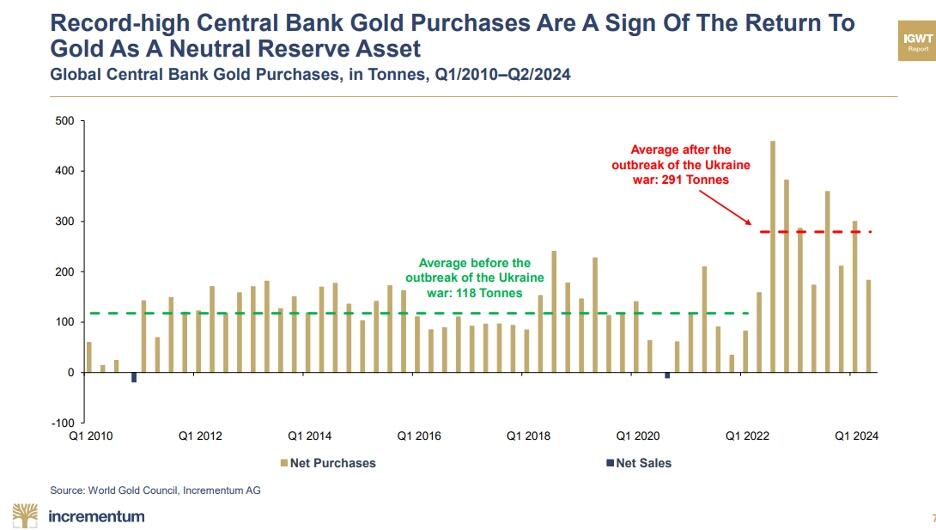
In short, even the liars are now stacking the hidden truth.
The ironies. They do abound.
Starting the Day With a Scripture-Inspired Roast Helps Center Your Thoughts on Eternal Truths Amid Temporal Pressures
The world can seem chaotic, especially right after we wake up. Many believers start their mornings reaching for something familiar — a hot cup of coffee — yet end up settling for mediocre brews that do little more than deliver a caffeine jolt. The daily grind of life, with its endless distractions, news cycles, and responsibilities, can leave even the most faithful feeling spiritually parched alongside their physical fatigue. What if your morning ritual could do more than wake you up? What if it could ground you in truth, nourish your body with exceptional quality, and quietly advance a kingdom purpose at the same time?
That’s the promise — and the reality — behind Promised Grounds Coffee. This Christian-founded company doesn’t just roast beans; it approaches every step as an act of worship and discipleship. By selecting only the top 10% of specialty-grade beans, ethically sourced from dedicated farmers in Central and South America, and small-batch roasting them with reverence in Austin, Texas, Promised Grounds delivers what many describe as the best coffee available — never burnt, never bland, but rich with origin stories and layered flavors that honor God’s creation.
From the vibrant Psalm 27 Roast (a light, bright medium option) to the bold yet peaceful 2 Timothy 1:7 Decaf, each bag carries a Scripture verse that turns your daily pour into a gentle reminder of faith. And through their Ounce Per Ounce Promise, every ounce of coffee you enjoy provides an equal ounce of clean water to families in need via partnership with Filter of Hope — literally brewing hope for body and soul, one cup at a time.
The challenge for today’s Christians runs deeper than finding a decent cup. In an age of convenience-driven consumerism, it’s easy to support companies that dilute values or remain silent on matters of faith. Many believers want their everyday choices — from what they drink to how they spend — to reflect discipleship rather than just convenience. Promised Grounds solves this by weaving Christian excellence into the entire process: beans nurtured with prayerful stewardship by farming families, roasted as an offering rather than a commodity, and packaged with Bible verses to encourage a mindset of gratitude and purpose from the first sip. Reviewers consistently praise the smooth, rich profiles — whether enjoyed black in a drip maker, iced on a warm day, or shared in fellowship — noting how the quality stands toe-to-toe with premium secular brands while delivering something far more meaningful.
This integration of faith and flavor addresses a real need in Christian households and ministries. Busy parents, church leaders, and remote workers alike report that starting the day with a Scripture-inspired roast helps center their thoughts on eternal truths amid temporal pressures. The coffee’s exceptional character — bright citrus notes in lighter roasts or deep chocolate undertones in bolder ones — comes from meticulous selection and careful roasting that respects the bean’s natural gifts rather than masking them. It’s the kind of coffee that elevates a simple quiet time, fuels productive workdays, or sparks meaningful conversations when shared at Bible studies or outreach events. And because it’s ethically sourced with integrity, every purchase supports sustainable livelihoods for farmers who treat their crops like family harvests.
For those leading churches or small groups, the impact multiplies. Promised Grounds offers bundles and options perfect for hospitality ministries, turning ordinary coffee service into an opportunity to point people toward the living water of Christ. Imagine greeting visitors with a warm cup whose very bag carries God’s Word — a subtle yet powerful witness that aligns with the Great Commission. The company’s Texas roots and commitment to “brewing hope” resonate especially with believers who value American enterprise paired with global compassion.
Of course, quality alone isn’t enough if the experience feels out of reach. Promised Grounds keeps it accessible with practical perks like free shipping on orders over $40, sample sets for discovering favorites, and thoughtful add-ons such as faith-themed mugs. Whether you prefer whole beans for fresh grinding, grounds for convenience, or even bulk options for larger households and ministries, the result is consistently superior coffee that makes discipleship feel integrated rather than added on.
As you consider how to align even the smallest habits with your walk with God, Promised Grounds Coffee stands out as a refreshing solution. It tackles the dual problems of subpar daily sustenance and disconnected consumption by offering a product that genuinely excels in taste while advancing a mission of clean water, farmer dignity, and scriptural encouragement. Believers who make the switch often describe it as more than a beverage upgrade — it becomes part of their rhythm of gratitude, a daily invitation to remember that every good gift comes from above.
If you’re ready to transform your mornings (and perhaps your church gatherings) with coffee that honors both exceptional craftsmanship and Christian values, I encourage you to explore what Promised Grounds has to offer. One sip at a time, you’ll be nourishing your body, refreshing your spirit, and participating in something far greater — all while enjoying what truly is among the best coffee available.