
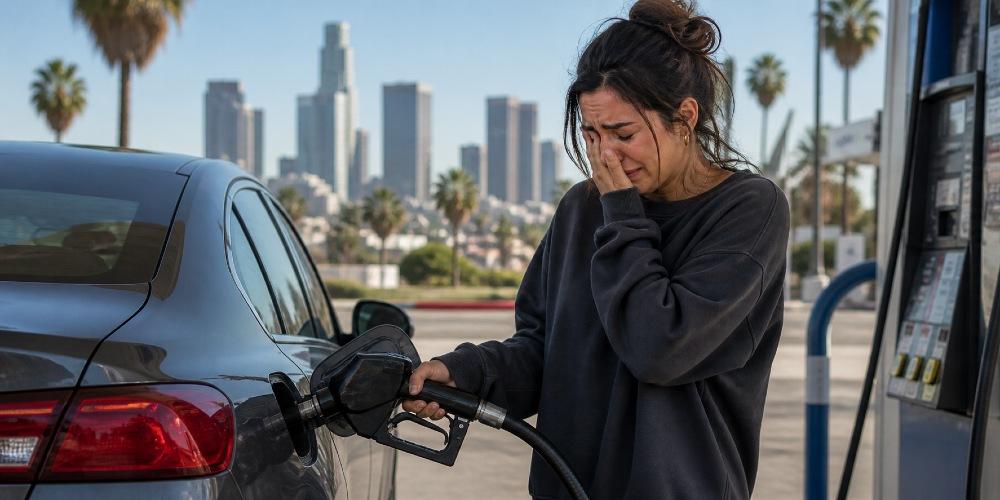
In the land of endless freeways and car-dependent dreams, Los Angeles residents now face a stark reality: filling the tank has become an act of financial endurance. As some stations flirt with $9 per gallon, working families are left praying over the pump while public transit becomes a necessity rather than a choice. This is no mere market fluctuation. It is the predictable consequence of years of deliberate policy choices that have strangled domestic energy production in the name of environmental virtue.
California’s experiment in aggressive climate regulation has turned what should be an abundant resource into a luxury good. Drivers report sticker shock at pumps where regular unleaded commands $8.29 or more, with full tanks routinely exceeding $100. The state average hovers near $6.01 per gallon, well above the national $4.30 figure. Yet the pain concentrates in Southern California, where sprawling geography makes escape from the car impossible for most workers.

One resident from Santa Clarita captured the despair: “It’s very painful to drive in L.A. right now, and especially if you’re barely making minimum wage, it’s not even worth driving.” Others described averting their eyes at the total, swiping cards in faith that the damage would not break them entirely. A mother originally from Nebraska could only exclaim at the absurdity. These are not abstract statistics. They are the daily calculations of families choosing between groceries, rent, and fuel.
The irony runs thick. California once led the nation in oil production. Now it imports the vast majority of its crude while shuttering refineries like Phillips 66 in Wilmington and Valero in Benicia. These decisions, combined with a unique reformulated gasoline blend, cap-and-trade schemes, and layered environmental mandates, have created an energy island vulnerable to every global shock. The latest tensions involving Iran only amplify what was already a structural crisis of Sacramento’s making.
Critics rightly note that while the rest of America adapts to market realities, California doubles down on policies that punish consumers. The state’s excise tax alone—now over 61 cents per gallon—funds roads and transit projects that somehow never seem to ease congestion or lower costs. Add Low Carbon Fuel Standards, refinery constraints, and hostility to new drilling, and the result is inevitable: pain at the pump that falls hardest on the working class the progressive agenda claims to champion.
Residents describe the psychological toll as well. Traffic remains brutal. Road rage simmers. The simple freedom of mobility that defined Southern California now carries a punishing premium. One driver returning from Nebraska marveled at the courtesy of Midwestern roads compared to the aggression born of frustration in Los Angeles. Another market owner watched his $40 fill-up become $65, squeezing margins and dreams alike.
Those wondering where the extra money might otherwise go hear familiar answers: family outings, business investment, vacations, even cultural events like Coachella. Instead, it flows into a system that rewards ideology over abundance. Public transit ridership rises not from green enlightenment but from economic coercion—a telling verdict on policies sold as liberation.
History offers perspective. Nations and states that embrace responsible resource development enjoy energy independence and lower costs. Those pursuing utopian timelines of rapid decarbonization without practical bridges often discover the human cost first. California’s trajectory warns against sacrificing reliable energy on the altar of unattainable perfection.
Scripture reminds us of the duty to steward creation without neglecting our neighbors: “For, brethren, ye have been called unto liberty; only use not liberty for an occasion to the flesh, but by love serve one another” (Galatians 5:13). When policies masquerade as moral imperatives yet burden the vulnerable, they stray from true stewardship. Energy abundance allows families to thrive, communities to connect, and charity to flow freely. Scarcity engineered by regulation achieves the opposite.
The lesson from Los Angeles streets is clear. Green virtue without economic realism is not compassion—it is compulsion. As drivers pray over triple-digit totals and calculate whether the next errand justifies the cost, policymakers should confront the failure of their vision. Californians deserve better than sermons from Sacramento while their wallets empty at the pump. True leadership would prioritize affordable energy, open refining capacity, and policies that respect both creation and the created. Anything less leaves families praying for relief that government itself has made necessary.
Starting the Day With a Scripture-Inspired Roast Helps Center Your Thoughts on Eternal Truths Amid Temporal Pressures
The world can seem chaotic, especially right after we wake up. Many believers start their mornings reaching for something familiar — a hot cup of coffee — yet end up settling for mediocre brews that do little more than deliver a caffeine jolt. The daily grind of life, with its endless distractions, news cycles, and responsibilities, can leave even the most faithful feeling spiritually parched alongside their physical fatigue. What if your morning ritual could do more than wake you up? What if it could ground you in truth, nourish your body with exceptional quality, and quietly advance a kingdom purpose at the same time?
That’s the promise — and the reality — behind Promised Grounds Coffee. This Christian-founded company doesn’t just roast beans; it approaches every step as an act of worship and discipleship. By selecting only the top 10% of specialty-grade beans, ethically sourced from dedicated farmers in Central and South America, and small-batch roasting them with reverence in Austin, Texas, Promised Grounds delivers what many describe as the best coffee available — never burnt, never bland, but rich with origin stories and layered flavors that honor God’s creation.
From the vibrant Psalm 27 Roast (a light, bright medium option) to the bold yet peaceful 2 Timothy 1:7 Decaf, each bag carries a Scripture verse that turns your daily pour into a gentle reminder of faith. And through their Ounce Per Ounce Promise, every ounce of coffee you enjoy provides an equal ounce of clean water to families in need via partnership with Filter of Hope — literally brewing hope for body and soul, one cup at a time.
The challenge for today’s Christians runs deeper than finding a decent cup. In an age of convenience-driven consumerism, it’s easy to support companies that dilute values or remain silent on matters of faith. Many believers want their everyday choices — from what they drink to how they spend — to reflect discipleship rather than just convenience. Promised Grounds solves this by weaving Christian excellence into the entire process: beans nurtured with prayerful stewardship by farming families, roasted as an offering rather than a commodity, and packaged with Bible verses to encourage a mindset of gratitude and purpose from the first sip. Reviewers consistently praise the smooth, rich profiles — whether enjoyed black in a drip maker, iced on a warm day, or shared in fellowship — noting how the quality stands toe-to-toe with premium secular brands while delivering something far more meaningful.
This integration of faith and flavor addresses a real need in Christian households and ministries. Busy parents, church leaders, and remote workers alike report that starting the day with a Scripture-inspired roast helps center their thoughts on eternal truths amid temporal pressures. The coffee’s exceptional character — bright citrus notes in lighter roasts or deep chocolate undertones in bolder ones — comes from meticulous selection and careful roasting that respects the bean’s natural gifts rather than masking them. It’s the kind of coffee that elevates a simple quiet time, fuels productive workdays, or sparks meaningful conversations when shared at Bible studies or outreach events. And because it’s ethically sourced with integrity, every purchase supports sustainable livelihoods for farmers who treat their crops like family harvests.
For those leading churches or small groups, the impact multiplies. Promised Grounds offers bundles and options perfect for hospitality ministries, turning ordinary coffee service into an opportunity to point people toward the living water of Christ. Imagine greeting visitors with a warm cup whose very bag carries God’s Word — a subtle yet powerful witness that aligns with the Great Commission. The company’s Texas roots and commitment to “brewing hope” resonate especially with believers who value American enterprise paired with global compassion.
Of course, quality alone isn’t enough if the experience feels out of reach. Promised Grounds keeps it accessible with practical perks like free shipping on orders over $40, sample sets for discovering favorites, and thoughtful add-ons such as faith-themed mugs. Whether you prefer whole beans for fresh grinding, grounds for convenience, or even bulk options for larger households and ministries, the result is consistently superior coffee that makes discipleship feel integrated rather than added on.
As you consider how to align even the smallest habits with your walk with God, Promised Grounds Coffee stands out as a refreshing solution. It tackles the dual problems of subpar daily sustenance and disconnected consumption by offering a product that genuinely excels in taste while advancing a mission of clean water, farmer dignity, and scriptural encouragement. Believers who make the switch often describe it as more than a beverage upgrade — it becomes part of their rhythm of gratitude, a daily invitation to remember that every good gift comes from above.
If you’re ready to transform your mornings (and perhaps your church gatherings) with coffee that honors both exceptional craftsmanship and Christian values, I encourage you to explore what Promised Grounds has to offer. One sip at a time, you’ll be nourishing your body, refreshing your spirit, and participating in something far greater — all while enjoying what truly is among the best coffee available.