
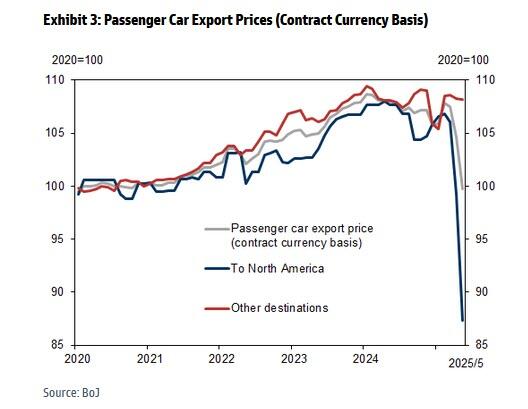
(ZeroHedge)—Last week, we sparked a stir within the financial community when we were the first to show, clearly and without doubt, that contrary to months of false narratives by the liberal “expert” class, the costs of Trump’s tariffs are actually not borne by either US companies or US consumers, but rather by the exporting nation and its manufacturers. In this particular case, we showed that Japan’s passenger car export prices to North America had plunged since Liberation Day, making it abundantly clear that it was indeed the Toyotas and Nissans of the world that were footing the bill of those extra $20 billion or so in month tariff revenues generated by the Trump admin.
We were referencing Japan’s May trade data, which showed that car exports to the US declined 24.7% by value in May, but only 3.9% by volume, as Japanese carmakers took a big hit to their profits by slashing prices to maintain shipments and market share.
Yet this data was so very much against conventional wisdom and the fake mental models the TDS crew had constructed, that virtually not a single member of the anti-Trump echo chamber believed the findings, even when our discovery was presented by Congressman Bernie Moreno to the Fed chair a few days later as evidence that contrary to his fears, US inflation isn’t soaring for the simple reason that costs are not being borne by domestic consumers (fast forward to 5 minutes in).

Yet still the TDS echo chamber would deny what was presented to them clear as day.
But fast forward to today, when we can finally lay this matter to rest.
This morning, none other than Japan’s Nikkei, admitted that for the past three months it was none other than Japan’s car industry that had been footing all the tariff-related costs following Trump’s Liberation Day announcement.
According to the Nikkei, “Japanese automakers kept prices unchanged at first after the tariffs were imposed.” It then goes on to state what our readers already knew, namely that “the unit price of Japanese automobile exports to the U.S. in May fell about 20% on the year, according to Japan’s Ministry of Finance, indicating that Japanese automakers have been trying to absorb the cost of tariffs.”
One correction to the esteemed Japanese media outlet: not “trying”, but succeeding, simply because automakers have had no choice: sure, they could have hiked prices long ago but the outcome would be a collapse in demand for Japanese cars, with market share taken over by domestic producers and other, cheaper, foreign automakers.
All of this is taking place as trade talk negotiations between the US and Japan are going nowhere, and in fact, Tokyo had gotten so emboldened by the theatrical standoff between Washington and Beijing, it thought it could get away with simply demanding away US tariffs. As a result, despite weeks of negotiation, the US-Japan teams have gotten nowhere with just one week left to go until the July 9 deadline, which is why Trump lashed out – in a very polite fashion – at the “spoiled” mercantilist Japan, which refuses to make any compromises.
“We dealt with Japan. I’m not sure if we’re going to make a deal. I doubt it with Japan — they’re very tough. You have to understand, they’re spoiled. I love Japan. I really like the new prime minister, too. Abe was one of my closest friends, as you know,” Trump said on Tuesday, referring to former Japanese prime minister Shinzo Abe who died in a 2022 assassination, explaining why there likely won’t be a trade deal with Japan.
Trump noted this week that Japan has a rice crisis that has elevated prices, arguing the country should turn to the U.S. for rice.
“But they and others are so spoiled from having ripped us off for 30, 40 years that it’s really hard for them to make a deal. You know, it’s very hard. As an example with Japan, they won’t take rice, and yet they desperately need rice,” he said. “They won’t take any cars, but they’ll sell millions. So, we told them, ‘Sorry you can’t do that.’”
The president said Japan will likely get a letter that would set the tariff rate ahead of the July 8 expiration of the 90-day pause on country-specific tariffs. Trump has said he will send letters soon to trading partners who haven’t struck deals.
“So what I’m going to do is I’ll write them a letter, say, ‘We thank you very much. We know you can’t do the kind of things that we need, and therefore you’ll pay a 30 percent, 35 percent or whatever the numbers that we determine,’” he said. “Because we also have a very big trade deficit with Japan, as you know and it’s very unfair to the American people.”
In other words, Trump has effectively assured Japan would be hit with across-the-board tariffs of up to 35% on its exports to the US, beyond the 24% penciled in on July 9.
In response, Japan prime minister Ishiba said that American cars “are a tough sell in Japan” adding that his government needs to discuss with the US how to boost car imports from America.

“We can’t sell left-hand drive, huge, fuel-inefficient cars made in the US,” Ishiba said Wednesday, and he probably wasn’t wrong. “We’ll discuss with the US how to produce better products and bring them into Japan, while considering Japan’s safety.”
In a Fox News interview on Sunday, Trump lashed out at Japan over cars: “So we give Japan no cars. They won’t take our cars, right? And yet we take millions and millions of their cars into the United States. It’s not fair.”
So what does Japan do now? Well, after eating billions of dollars in losses for months, the local carmakers are literally on the verge of collapse, and they are now trial ballooning that they have no choice but to do what everyone assumed they would do from day one: raise prices.
According to the Nikkei, Subaru and Mitsubishi Motors have started to raise prices while Mazda Motor is exploring doing so (none of this is actually reflected stateside yet). According to the Nikkei, “they have little choice but to raise prices, having reached their limit in absorbing cost increases.”
Which is precisely what we warned back in March when we said that “Japanese Carmakers Face Catastrophic Profit Hit From Trump’s Auto Tariffs.” Well, the profit hit is here, and in a few weeks it will translate into one of the biggest recessions Japan has ever faces in modern history, forcing the BOJ to unleash an unprecedented stimulus, while pushing rates back to zero or negative.
And since Tokyo will be back to resorting to the oldest trick in the book, namely sending the yen crashing to offset the tariff costs – we fully expect USDJPY to hit 160 in the next 6 months – Trump is about to get a whole lot angrier at Japan and its soon-to-crash currency, at which point the world will finally move on from trade wars to currency wars and capital controls.

Starting the Day With a Scripture-Inspired Roast Helps Center Your Thoughts on Eternal Truths Amid Temporal Pressures
The world can seem chaotic, especially right after we wake up. Many believers start their mornings reaching for something familiar — a hot cup of coffee — yet end up settling for mediocre brews that do little more than deliver a caffeine jolt. The daily grind of life, with its endless distractions, news cycles, and responsibilities, can leave even the most faithful feeling spiritually parched alongside their physical fatigue. What if your morning ritual could do more than wake you up? What if it could ground you in truth, nourish your body with exceptional quality, and quietly advance a kingdom purpose at the same time?
That’s the promise — and the reality — behind Promised Grounds Coffee. This Christian-founded company doesn’t just roast beans; it approaches every step as an act of worship and discipleship. By selecting only the top 10% of specialty-grade beans, ethically sourced from dedicated farmers in Central and South America, and small-batch roasting them with reverence in Austin, Texas, Promised Grounds delivers what many describe as the best coffee available — never burnt, never bland, but rich with origin stories and layered flavors that honor God’s creation.
From the vibrant Psalm 27 Roast (a light, bright medium option) to the bold yet peaceful 2 Timothy 1:7 Decaf, each bag carries a Scripture verse that turns your daily pour into a gentle reminder of faith. And through their Ounce Per Ounce Promise, every ounce of coffee you enjoy provides an equal ounce of clean water to families in need via partnership with Filter of Hope — literally brewing hope for body and soul, one cup at a time.
The challenge for today’s Christians runs deeper than finding a decent cup. In an age of convenience-driven consumerism, it’s easy to support companies that dilute values or remain silent on matters of faith. Many believers want their everyday choices — from what they drink to how they spend — to reflect discipleship rather than just convenience. Promised Grounds solves this by weaving Christian excellence into the entire process: beans nurtured with prayerful stewardship by farming families, roasted as an offering rather than a commodity, and packaged with Bible verses to encourage a mindset of gratitude and purpose from the first sip. Reviewers consistently praise the smooth, rich profiles — whether enjoyed black in a drip maker, iced on a warm day, or shared in fellowship — noting how the quality stands toe-to-toe with premium secular brands while delivering something far more meaningful.
This integration of faith and flavor addresses a real need in Christian households and ministries. Busy parents, church leaders, and remote workers alike report that starting the day with a Scripture-inspired roast helps center their thoughts on eternal truths amid temporal pressures. The coffee’s exceptional character — bright citrus notes in lighter roasts or deep chocolate undertones in bolder ones — comes from meticulous selection and careful roasting that respects the bean’s natural gifts rather than masking them. It’s the kind of coffee that elevates a simple quiet time, fuels productive workdays, or sparks meaningful conversations when shared at Bible studies or outreach events. And because it’s ethically sourced with integrity, every purchase supports sustainable livelihoods for farmers who treat their crops like family harvests.
For those leading churches or small groups, the impact multiplies. Promised Grounds offers bundles and options perfect for hospitality ministries, turning ordinary coffee service into an opportunity to point people toward the living water of Christ. Imagine greeting visitors with a warm cup whose very bag carries God’s Word — a subtle yet powerful witness that aligns with the Great Commission. The company’s Texas roots and commitment to “brewing hope” resonate especially with believers who value American enterprise paired with global compassion.
Of course, quality alone isn’t enough if the experience feels out of reach. Promised Grounds keeps it accessible with practical perks like free shipping on orders over $40, sample sets for discovering favorites, and thoughtful add-ons such as faith-themed mugs. Whether you prefer whole beans for fresh grinding, grounds for convenience, or even bulk options for larger households and ministries, the result is consistently superior coffee that makes discipleship feel integrated rather than added on.
As you consider how to align even the smallest habits with your walk with God, Promised Grounds Coffee stands out as a refreshing solution. It tackles the dual problems of subpar daily sustenance and disconnected consumption by offering a product that genuinely excels in taste while advancing a mission of clean water, farmer dignity, and scriptural encouragement. Believers who make the switch often describe it as more than a beverage upgrade — it becomes part of their rhythm of gratitude, a daily invitation to remember that every good gift comes from above.
If you’re ready to transform your mornings (and perhaps your church gatherings) with coffee that honors both exceptional craftsmanship and Christian values, I encourage you to explore what Promised Grounds has to offer. One sip at a time, you’ll be nourishing your body, refreshing your spirit, and participating in something far greater — all while enjoying what truly is among the best coffee available.