
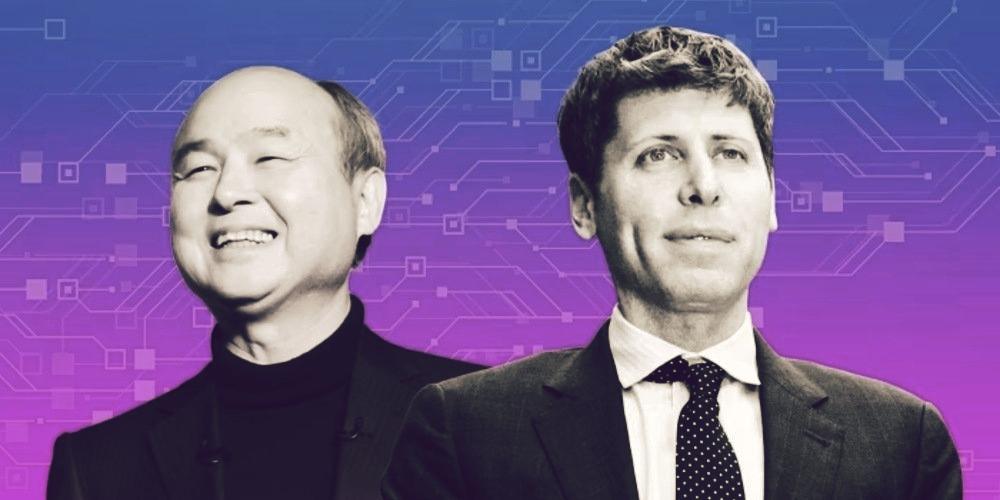
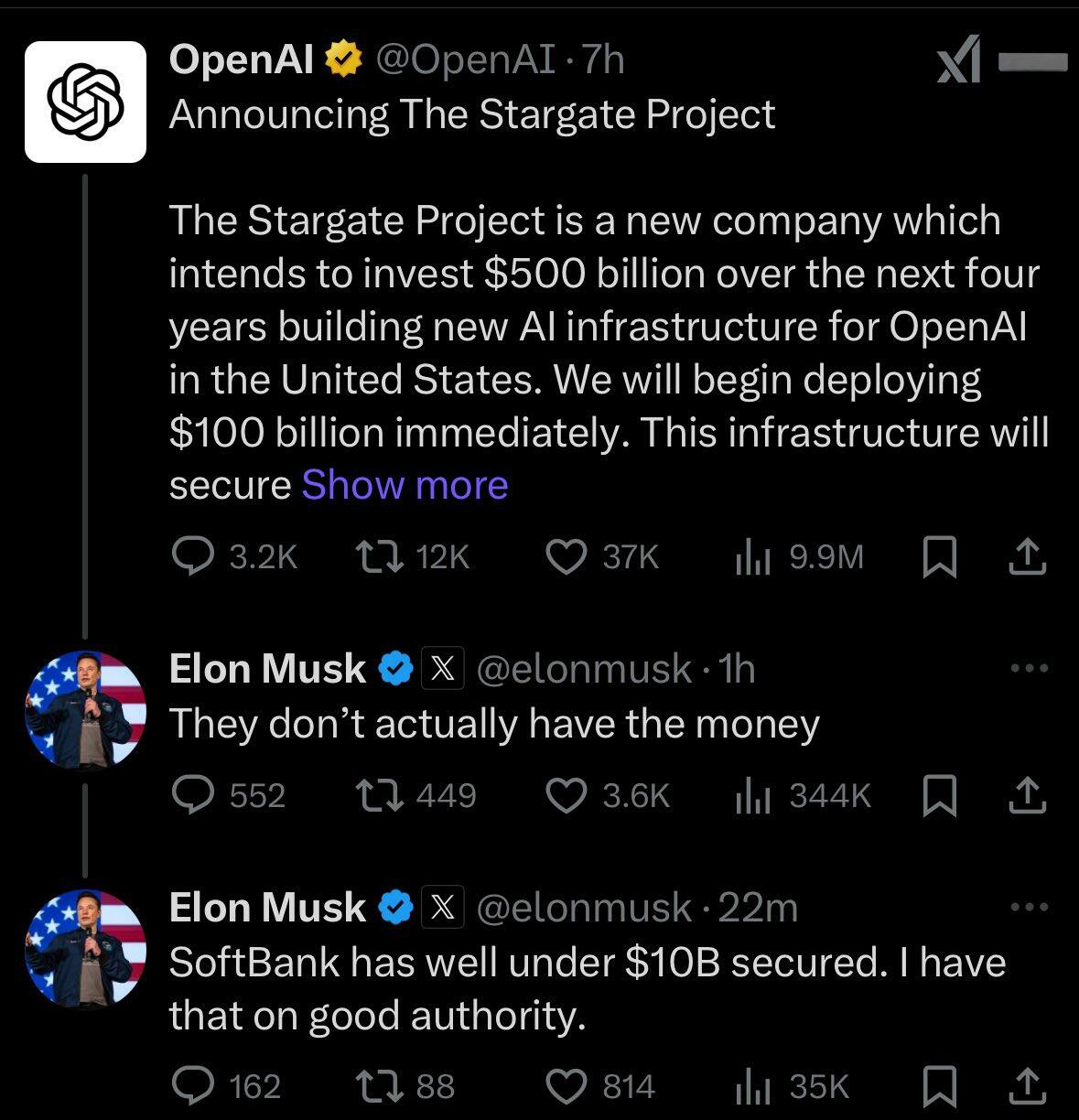
(ZeroHedge)—Back in January, when the AI trade got its latest kick higher thanks to an announcement by the newly-created “Stargate” project between OpenAI and Japan’s cartoonish momo-chasing titan Masa Son and his conglomerate SoftBank, that the initiative would spend $500 billion over 4 years to build new AI infrastructure for OpenAI in the US and would deploy $100 billion “immediately”, we said that this was one giant pipe dream as the initiative was “spending $100BN in money which does not exist to generate IRR which are not positive.” In other words, just another SoftBank special: pretending to throw crazy amounts of money which Masa Son simply does not have.
Elon Musk, whose feud with OpenAI Sam Altman is one of the defining billionaire rivalries of our time, was even more forthright, and echoed our sentiment when he said that “they don’t actually have the money.”

Not surprisingly we, and Elon, were right.
As the WSJ reported overnight, the $500 billion “effort” unveiled at the White House to supercharge the U.S.’s artificial-intelligence ambitions has struggled to get off the ground and has sharply scaled back its near-term plans.
Six months after Japanese billionaire Masayoshi Son stood shoulder to shoulder with Sam Altman and President Trump to announce the Stargate project, the newly formed company charged with making it happen has yet to complete a single deal for a data center.
But it’s not just the lack of any actual capital that’s a problem: it turns out that putting two narcissistic egomaniacs in the same room is not conducive to smoothly flowing consensus; instead the two have been “at odds over crucial terms of the partnership, including where to build the sites, according to people familiar with the matter.”
While the companies pledged at the January announcement to invest $100 billion “immediately,” the project is now setting the more modest goal of building a small data center by the end of this year, likely in Ohio, the people said.
Stargate’s lethargic launch is a setback to the vast ambitions of Son, who despite spending billions of dollars over the years, has been playing catch-up in the fast-evolving AI sector.
Earlier this year, SoftBank committed $30 billion to OpenAI… money, which it does not have. Which is hardly a surprise to anyone familiar with the company best known for its catastrophic investment in WeWork and countless other failures. Hoping to make everyone forget what a horrible investor it actually is, SoftBank upped the ante to ridiculous proportions making its AI bet by far the largest-ever startup investment — an enormous wager that has led SoftBank to take on new debt and sell assets. The investment was made alongside the plans for Stargate, giving SoftBank a role in the physical infrastructure needed for AI.
Meanwhile Altman, who actually does have some money, has been eager to secure the computing power to support the next generations of his company’s signature product, ChatGPT, has plowed ahead without SoftBank, signing deals for data centers with other operators.
Naturally, the leaders of both companies are lying that all is well in their joint effort. Last week they appeared on video at a SoftBank event, and Altman said they have an initial goal of building 10 gigawatts of data centers together. It is a “wonderful partnership,” he said… and the handful of people who watched couldn’t help but laugh.
In a joint statement, the two companies used even more laughable jargon, claiming they were advancing projects in multiple states and were “moving at hyperscale and speed to deliver the AI infrastructure that will power the future and serve humanity.”
Yet despite Stargate’s rocky start, it hasn’t slowed the data-center development spree that Trump has said is a national priority. AI enthusiasts say the world will require a gargantuan effort to build the warehouse-like structures filled with computer servers, and the electricity needed to supply them, on par with the construction of railroads in the 19th century.
Altman’s OpenAI recently struck a data-center deal with Oracle that calls for OpenAI to pay more than $30 billion a year to the software and cloud-computing company starting within three years. The deal, which may or may not go live in about 4-5 years, has already helped send ORCL stock to record highs, more than doubling where it was just back in April.
That deal, which doesn’t involve SoftBank, totals 4.5 gigawatts of capacity, and would consume the equivalent power of more than two Hoover Dams, enough to power about four million homes. The data centers are spread among locations around the U.S. Of course, just like Stargate, that deal too will end up being nothing but lots of hot air.
According to the WSJ, taken with a smaller deal OpenAI struck with CoreWeave, OpenAI has now completed data-center deals for nearly as much capacity as Stargate promised for this year in January. (OpenAI has said $100 billion roughly equates to 5 gigawatts of data centers.)
Meanwhile, amid the catastrophic rollout of Stargate, Son has told associates he is bullish on OpenAI and would like to invest even more in the company. Yes, invest even more money he doesn’t have.
Masa Son, who has long been viewed as something of an anti-Buffett one-hit wonder in the investing world (his only actual success was Alibaba), has long craved a prominent seat at the AI table. And yet, despite devoting the two largest startup funds ever raised – more than $140 billion – to finding the AI companies of the future, Son missed out on OpenAI and all of its competitors before the launch of ChatGPT, while being tarred by high-profile flops such as WeWork and construction startup Katerra.
In the fall of 2024, at long last he zeroed in on OpenAI. But Altman had ambitions on a scale without precedent: He has said trillions of dollars will be needed to fund the next stages of AI.
In November, Son and Altman met in Tokyo to hash out an agreement. They next brought their plans to Trump aides with the offer of announcing a giant U.S. investment. On the second day of Trump’s new administration, they stood smiling in the White House beside Trump, vowing to spend $500 billion by 2029.
“This is the beginning of our golden age,” Son said at the White House, hoping that the bulk of the funding needs would be borne by US taxpayers. He was wrong.

At the start, OpenAI and SoftBank each pledged $18 billion to the venture to get started, which they expected would develop data centers and then lease them to OpenAI. The two companies said they would jointly control the entity, with Son as its chairman. SoftBank would focus on the financial details and OpenAI on the operations, the companies added.
That’s when the chaos really started: they named Oracle and U.A.E. firm MGX as partners in the initial announcement, but their role was unclear. No agreement setting out their investment levels had been reached at the time.
“Stargate is not formed yet,” Oracle Chief Executive Safra Katz said on an investor call last month.
One recent complication between OpenAI and SoftBank has been over how extensively to build data centers on sites tied to SB Energy, a SoftBank-backed energy developer, according to people familiar with the matter.
Meanwhile, Altman has used the Stargate name, shared with a B-grade 1994 Kurt Russell film about aliens who teleport to ancient Egypt, on projects that aren’t being financed by the partnership between OpenAI and SoftBank. The trademark to Stargate is held by SoftBank, according to public filings. For instance, OpenAI refers to a data center in Abilene, Texas, and another it agreed in March to use in Denton, Texas, as part of Stargate even though they are being done without SoftBank.
Which begs the question: where will all the money come from?
To be sure, as the WSJ notes, “building data centers isn’t easy. Companies need to find sites, develop the physical structures—or pay another company to do that—buy expensive AI chips, source vast loads of electricity and find lenders to cover much of the cost, among other details. Stargate is hoping to use a new, lower-cost design for its first project in Ohio.”
Training new, better AI models requires evermore data processing and constant sources of new capital, which means companies including OpenAI are committing to larger and larger spending well before the business models of AI companies have proved profitable. Indeed, so far most analyses suggest that the IRR of AI remains solidly negative.
Which again brings up the matter of money: OpenAI’s $30-billion-a-year deal with Oracle is roughly three times as much as what Altman’s company has recently projected in annual revenue. The company, which is losing billions of dollars a year, is betting its revenue will multiply thanks to the growing ranks of paying customers and advertising, allowing it to pay for its hefty commitments.
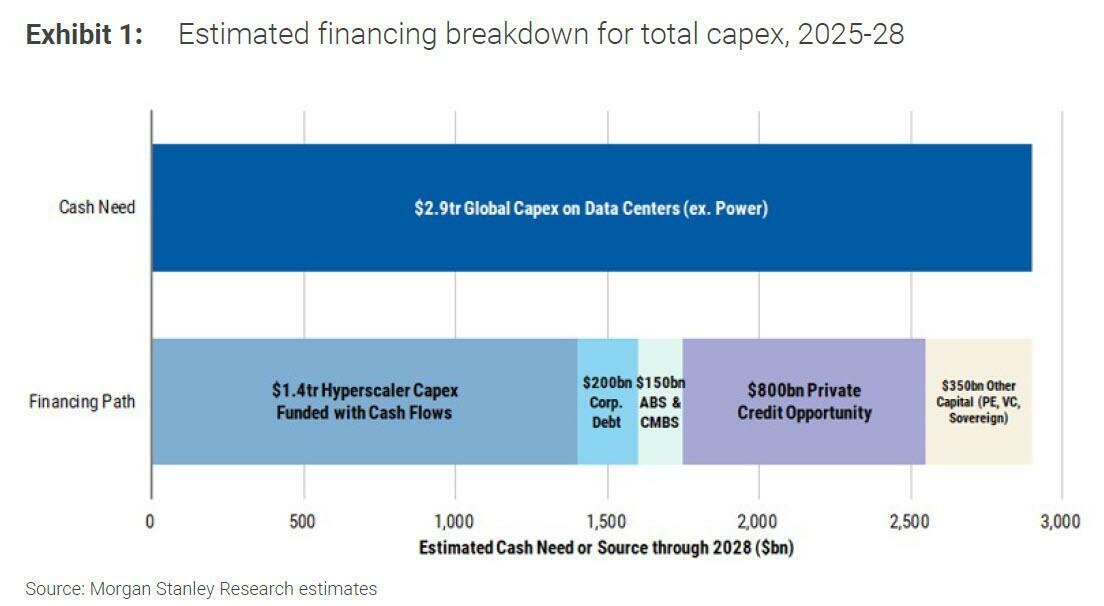
One – rather unpleasant – answer putting this all in context, comes from Morgan Stanley, which this weekend published some shocking new math: there is simply no way to pay for all the funding needs out of equity or cash flow, and “Paying For AI Capex Will Require Over $1 Trillion In New Debt By 2028”
Good luck with that, and good luck with those 50x forward AI valuations once the Koolaid finally wears off.
Starting the Day With a Scripture-Inspired Roast Helps Center Your Thoughts on Eternal Truths Amid Temporal Pressures
The world can seem chaotic, especially right after we wake up. Many believers start their mornings reaching for something familiar — a hot cup of coffee — yet end up settling for mediocre brews that do little more than deliver a caffeine jolt. The daily grind of life, with its endless distractions, news cycles, and responsibilities, can leave even the most faithful feeling spiritually parched alongside their physical fatigue. What if your morning ritual could do more than wake you up? What if it could ground you in truth, nourish your body with exceptional quality, and quietly advance a kingdom purpose at the same time?
That’s the promise — and the reality — behind Promised Grounds Coffee. This Christian-founded company doesn’t just roast beans; it approaches every step as an act of worship and discipleship. By selecting only the top 10% of specialty-grade beans, ethically sourced from dedicated farmers in Central and South America, and small-batch roasting them with reverence in Austin, Texas, Promised Grounds delivers what many describe as the best coffee available — never burnt, never bland, but rich with origin stories and layered flavors that honor God’s creation.
From the vibrant Psalm 27 Roast (a light, bright medium option) to the bold yet peaceful 2 Timothy 1:7 Decaf, each bag carries a Scripture verse that turns your daily pour into a gentle reminder of faith. And through their Ounce Per Ounce Promise, every ounce of coffee you enjoy provides an equal ounce of clean water to families in need via partnership with Filter of Hope — literally brewing hope for body and soul, one cup at a time.
The challenge for today’s Christians runs deeper than finding a decent cup. In an age of convenience-driven consumerism, it’s easy to support companies that dilute values or remain silent on matters of faith. Many believers want their everyday choices — from what they drink to how they spend — to reflect discipleship rather than just convenience. Promised Grounds solves this by weaving Christian excellence into the entire process: beans nurtured with prayerful stewardship by farming families, roasted as an offering rather than a commodity, and packaged with Bible verses to encourage a mindset of gratitude and purpose from the first sip. Reviewers consistently praise the smooth, rich profiles — whether enjoyed black in a drip maker, iced on a warm day, or shared in fellowship — noting how the quality stands toe-to-toe with premium secular brands while delivering something far more meaningful.
This integration of faith and flavor addresses a real need in Christian households and ministries. Busy parents, church leaders, and remote workers alike report that starting the day with a Scripture-inspired roast helps center their thoughts on eternal truths amid temporal pressures. The coffee’s exceptional character — bright citrus notes in lighter roasts or deep chocolate undertones in bolder ones — comes from meticulous selection and careful roasting that respects the bean’s natural gifts rather than masking them. It’s the kind of coffee that elevates a simple quiet time, fuels productive workdays, or sparks meaningful conversations when shared at Bible studies or outreach events. And because it’s ethically sourced with integrity, every purchase supports sustainable livelihoods for farmers who treat their crops like family harvests.
For those leading churches or small groups, the impact multiplies. Promised Grounds offers bundles and options perfect for hospitality ministries, turning ordinary coffee service into an opportunity to point people toward the living water of Christ. Imagine greeting visitors with a warm cup whose very bag carries God’s Word — a subtle yet powerful witness that aligns with the Great Commission. The company’s Texas roots and commitment to “brewing hope” resonate especially with believers who value American enterprise paired with global compassion.
Of course, quality alone isn’t enough if the experience feels out of reach. Promised Grounds keeps it accessible with practical perks like free shipping on orders over $40, sample sets for discovering favorites, and thoughtful add-ons such as faith-themed mugs. Whether you prefer whole beans for fresh grinding, grounds for convenience, or even bulk options for larger households and ministries, the result is consistently superior coffee that makes discipleship feel integrated rather than added on.
As you consider how to align even the smallest habits with your walk with God, Promised Grounds Coffee stands out as a refreshing solution. It tackles the dual problems of subpar daily sustenance and disconnected consumption by offering a product that genuinely excels in taste while advancing a mission of clean water, farmer dignity, and scriptural encouragement. Believers who make the switch often describe it as more than a beverage upgrade — it becomes part of their rhythm of gratitude, a daily invitation to remember that every good gift comes from above.
If you’re ready to transform your mornings (and perhaps your church gatherings) with coffee that honors both exceptional craftsmanship and Christian values, I encourage you to explore what Promised Grounds has to offer. One sip at a time, you’ll be nourishing your body, refreshing your spirit, and participating in something far greater — all while enjoying what truly is among the best coffee available.